Clocks · Clock
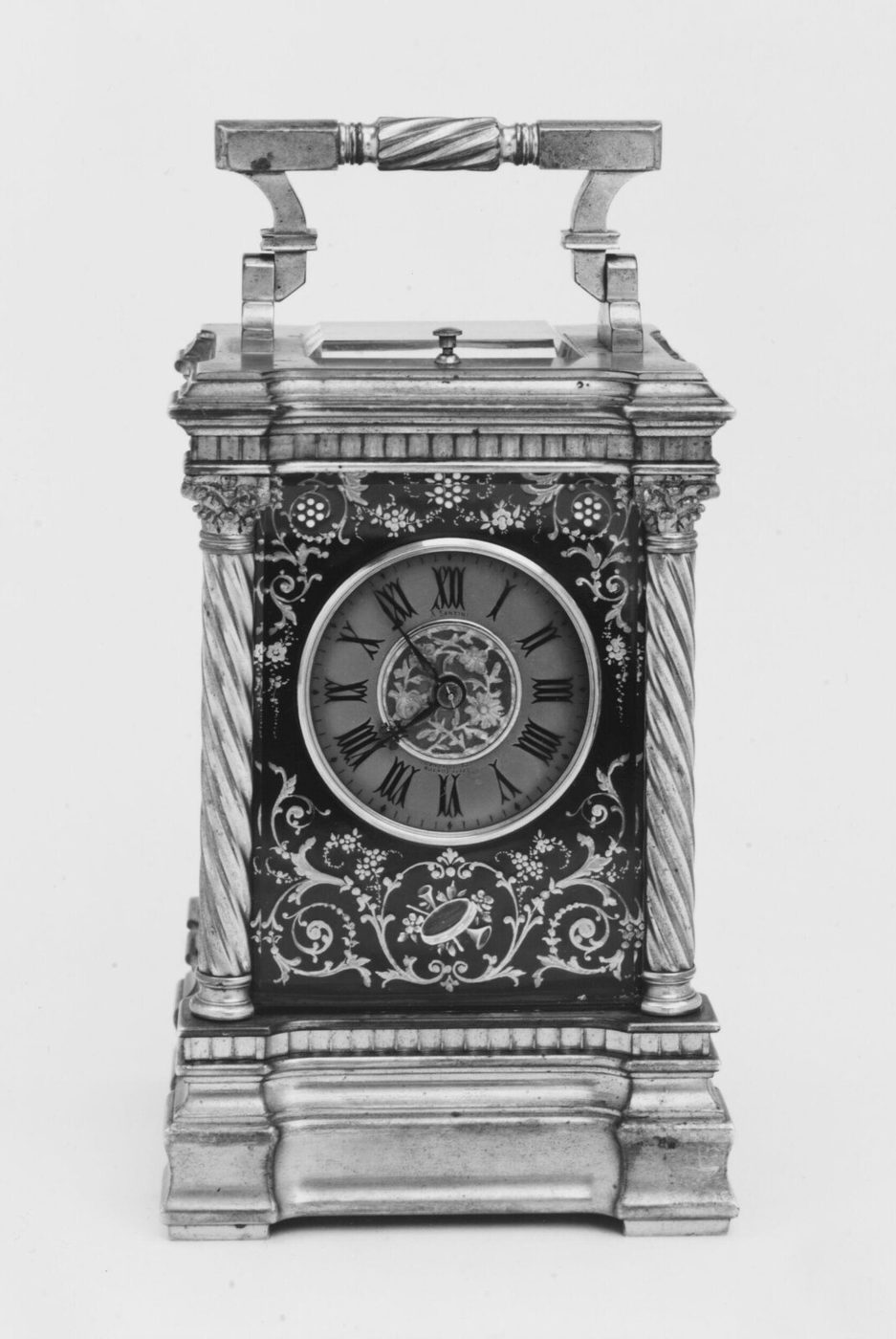
A gilt brass carriage clock, Buenos Aires, circa 1890, with two miniature portraits one representing Queen Marie Antoinette of France
- Maker / attribution
- Angel Santini (supplier)
- Date
- 1890
- Historical period
- Industrial Revolution (1850 – 1900)
- Country of origin
- Unrecorded in source
- Place
- Buenos Aires
- Object type
- Clock
- Materials / technique
- Gilt brass, enamel, watercolour, blued steel
- Dimensions
- Height: 15.6 cm; Width: 10.5 cm; Depth: 9.1 cm
- Holding institution
- Victoria and Albert Museum, London
- Accession / object no.
- M.2:1-1990
- Credit line
- Bequeathed by Miss Elizabeth Watts, 1990.
Record summary
Held and catalogued by Victoria and Albert Museum, London (object number M.2:1-1990), this is a clock by Angel Santini, made in Buenos Aires, dated 1890. The Atlas places it in the Industrial Revolution period (1850 – 1900) of its Clocks collection. Materials and techniques recorded by the source: Gilt brass, enamel, watercolour, blued steel. Recorded dimensions: Height: 15.6 cm; Width: 10.5 cm; Depth: 9.1 cm. The record is illustrated with 4 photographs.
Assembled from the source record's structured fields. Dates and attributions are given as the source states them; where a field is missing the Atlas leaves it blank rather than estimating.
Catalogue description
V&A — Summary
A gilt brass carriage clock supplied by A Santini, a retailer in Buenos Aires, circa 1890. It imitates late 18th century examples as the miniature portrait of the French Queen Marie Antoinette suggests. Bequeathed by Miss Elizabeth Watts, 1990.
V&A — Physical description
The case of gilt brass, the interior enamelled, set with two miniatures, the dial inscribed A SANTINI CANGALLO 90 BUENOS AYRES Of standard form, the frame of cast and gilt brass comprising a moulded base and top with four half 'barley sugar' columns. On the top are two mounts supporting a cast brass handle; in the top at the front and at the back are panels of bevelled glass; the interior is formed of three coffer panels covered with dark blue enamel. Each panel is painted in gold with scrolling foliage, and in white, with formalized flowers; a musical trophy in white is painted below the dial. Circular dial of gilt brass with painted numerals; finely cut hands of blued steel. On the dial is the name and address of a Buenos Aires retailer. In the centre is an applied floral mount in gilt brass; at either side of the case are oval miniatures on card representing Marie Antoinette and an unidentified lady. Standard movement of French type with repeater operated by a knob on top of the case, movement and case are stampted with the number 1880, and the frame with the number 8; base set with a later gilt copper plate on which are incised details of services carried out on the clock by S.J.Birt and Son of Brill, Buckingham, from November 1972-May 1988.
V&A — Historical context
A portable clock used for travelling
V&A — Object history
The clock was bequeathed by Miss Elizabeth Watt and its leather case was given to the Director of the V&A Mrs Elizabeth Esteve-Coll by a relative of Miss Watt in Scotland.
Inscriptions & marks
A SANTINI CANGALLO 90 BUENOS AYRES; An inscription on the base of the clock records services carried out on the clock by S.J.Birt and Son of Brill, Buckingham, from November 1972-May 1988.
Historical context
Industrial Revolution (1850 – 1900)
American interchangeable-parts manufacture; railroad time standards; Swiss and German factory systems.
Factory production transformed the clock into an everyday object. American makers (Seth Thomas, Ansonia, Waterbury) and German factories (Junghans, Gustav Becker, Lenzkirch) sold millions of shelf, wall and alarm clocks worldwide; France produced standardised Paris movements and carriage clocks; electric time distribution began.
Read the period in the timelineMore clocks from this periodEarlier: Precision & Scientific Horology
Atlas type guide
Carriage and travel clocks
The carriage clock is a portable spring clock with a balance-wheel escapement and a brass case with glass panels and a carrying handle. Abraham-Louis Breguet made early examples around 1800, and from the 1830s Paul Garnier and other French makers industrialised production, with the small towns of Saint-Nicolas-d'Aliermont and the Franche-Comté supplying movements for retailers worldwide.
Typical features include a platform escapement mounted horizontally on top of the movement (usually a lever, sometimes cylinder or Garnier's chaff-cutter), striking or repeating work, and alarms. English carriage clocks, generally larger and with fusees, were made by firms such as Frodsham and Dent. Travel clocks in folding leather cases became popular in the twentieth century.
What to look for
- A platform escapement visible through the top glass.
- Case styles: corniche, gorge, anglaise, obis or engraved cases.
- Repeat buttons on top and strike/silent levers.
- Stamps of movement makers (e.g. Drocourt, Jacot, Margaine, Richard & Co.) on the backplate.
Dating clues
- Early carriage clocks with Breguet or Garnier features: c. 1800–1850.
- Mass-produced French carriage clocks: c. 1850–1914.
- Folding travel clocks and alarm travel clocks: mostly 1920–1970.
General guidance written by the Atlas editors about this kind of object. It is not a statement about this particular piece; for that, rely on the source record above and on physical examination.
Read next:Detached lever escapement
Related records
Clocks · 1801-1900
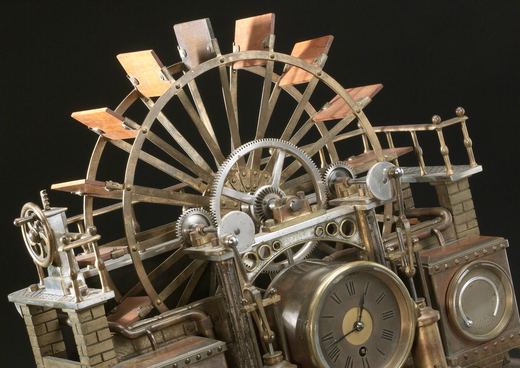
Clock (French) symbolising motive power, gilt bronze finish, with two keys, 1801-1900
Science Museum Group, London
Clocks · 1801-1900
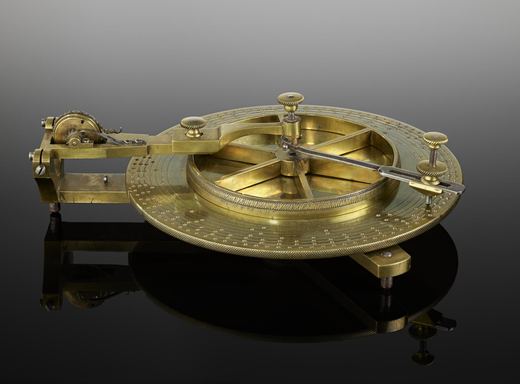
Instrument for ruling clock dials, 1800s.
Science Museum Group, London
Clocks · 1830-1870
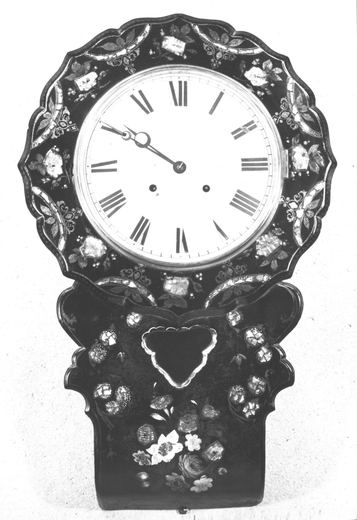
Wall clock in a papier mâché case with painted decoration. English, mid 19th century.
Victoria and Albert Museum, London
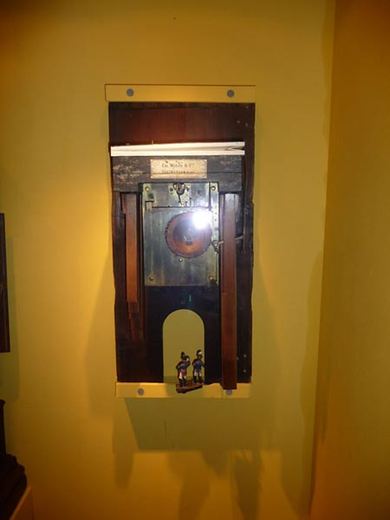
Clocks · 1832–1896
Clock by Emilian Wehrle, Germany, 1832–1896
Badisches Landesmuseum Karlsruhe
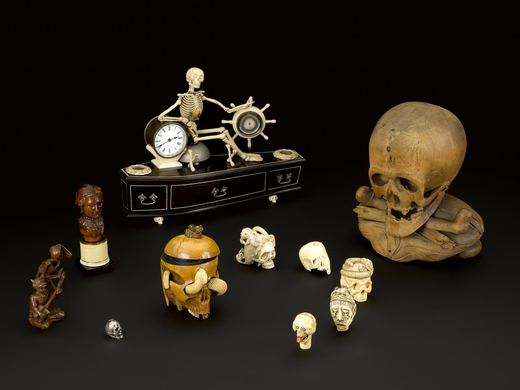
Clocks · 1840-1900
Alarm clock, mounted on model of coffin with skeleton, probably English, 1840-1900
Science Museum Group, London
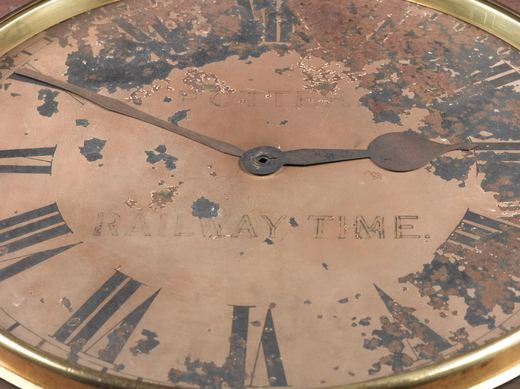
Clocks · 1840-1880
Clock dial marked "Potter, Railway Time" with two hands, unknown maker, British, 1840-1880
Science Museum Group, London
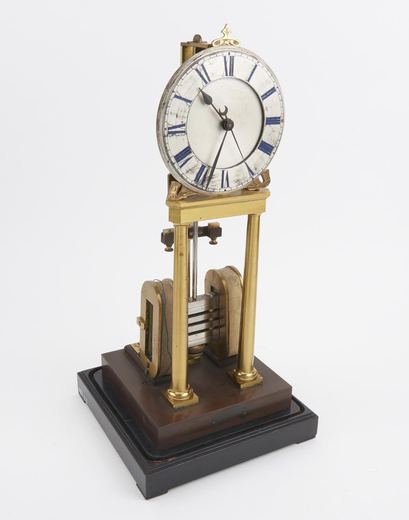
Clocks · 1840-1877
Electric clock of the Bain type
Science Museum Group, London
Clocks · 1840-1910
Electrically driven pendulum by Froment, 1840-1910.
Science Museum Group, London