Technical Horology · Technical explainer
Why the Lever Won: Two Centuries of the Detached Lever Escapement
Thomas Mudge's invention of the 1750s waited half a century for industry to catch up. Today it beats inside almost every mechanical watch on earth.
Atlas Editorial ·
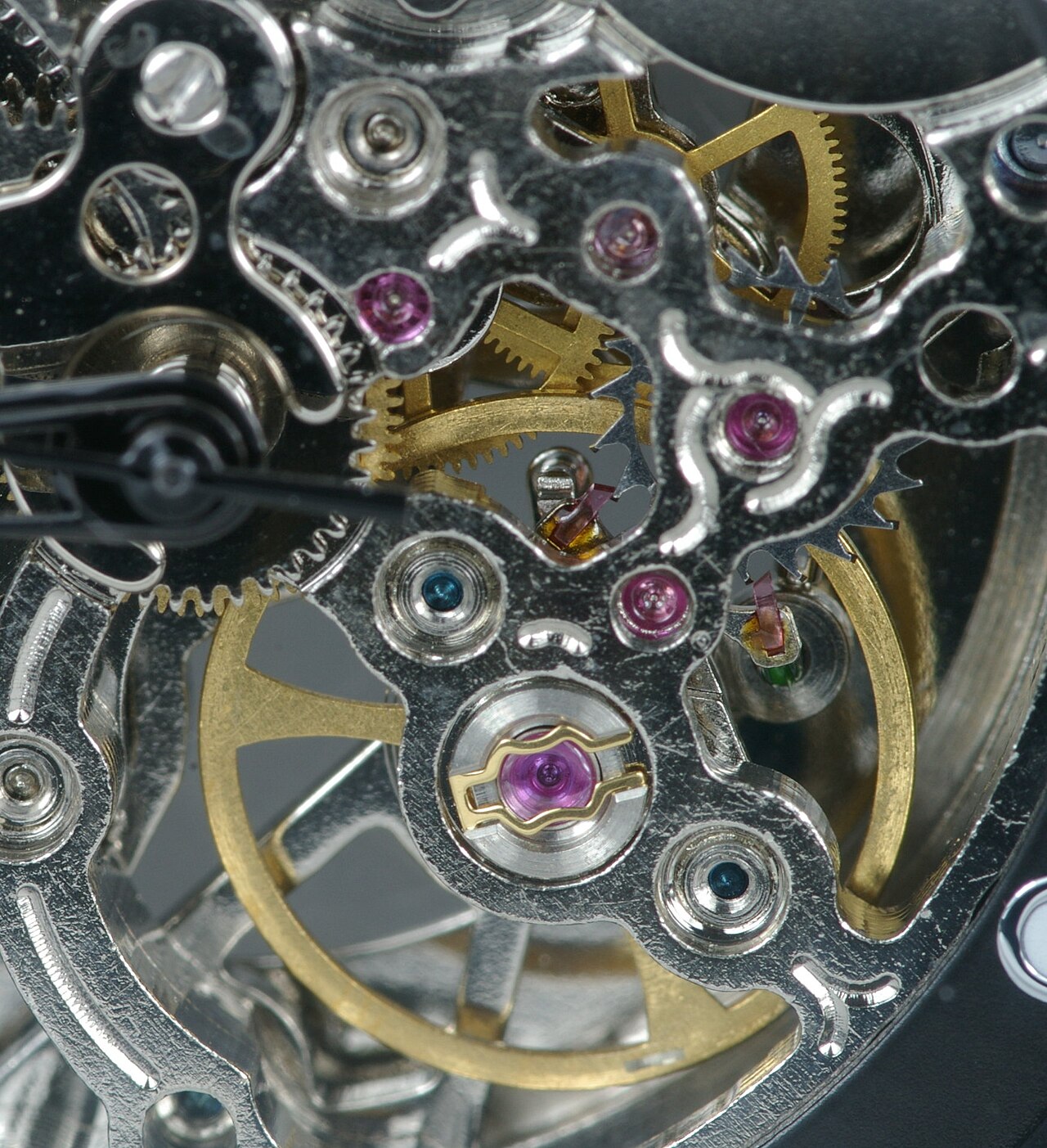
Hustvedt · CC BY-SA 3.0 · source
Open the caseback of almost any mechanical watch made in the last century and a half — a railway pocket watch, a military field watch, a luxury chronograph, an inexpensive automatic — and you will find the same small arrangement beating five to ten times a second: an escape wheel with club-shaped teeth, a forked lever carrying two jewelled pallets, and a balance wheel with a spiral hairspring. This is the detached lever escapement. Its dominance is so complete that it is easy to forget how long it took to win, and how many rivals it defeated along the way.
The problem the lever solved
A watch keeps time because its balance wheel, restored by the hairspring, oscillates at a natural frequency. Christiaan Huygens's spiral balance spring of 1675 gave the balance that natural frequency for the first time. But in the verge escapement then universal in watches, the balance was never free: the crown wheel pressed on the pallets throughout the swing, so any change in the driving force — from a running-down mainspring, from dirty oil, from a worn tooth — changed the rate. Watchmakers fought this with the fusee, which evened out the mainspring's torque, and with fine adjustment, but the fundamental coupling remained.
Mudge's invention
Thomas Mudge (1715–1794), a London watchmaker who had trained under George Graham, made the first known detached lever escapement around 1755. In his arrangement, a lever pivoted between the escape wheel and the balance. A pin on the balance — the impulse pin — entered a notch in the lever, swung it across, and in doing so unlocked the escape wheel; the wheel then pushed on the pallets, which drove the lever back against the impulse pin, giving the balance its impulse. The lever then came to rest against a banking, leaving the balance to complete its swing undisturbed.
Mudge fitted the escapement to a small number of pieces, including a celebrated watch later owned by Queen Charlotte. Yet he did not regard it as a commercial proposition. In a much-quoted letter he observed that the lever required such accuracy of execution that few artists could be found to make it. He was right: the geometry of the lever — the angles of lock, draw, impulse and drop — tolerated very little error, and the hand tools of the eighteenth century could not reproduce it economically.
The rivals
For the next seventy years, the lever was one escapement among many. Each rival had a real advantage, which is why each survived as long as it did.
| Escapement | Period of widest use | Detached? | Strengths | Weaknesses |
|---|---|---|---|---|
| Verge | c. 1300–1850 | No | Robust; tolerant of poor manufacture | Rate depends on driving force; thick watches |
| Cylinder | c. 1720s–1920s | No (frictional rest) | Thin, inexpensive; favoured in Swiss and French work | Wear of the cylinder; needs oil |
| Duplex | c. 1780–1860 | Partly | Good timekeeping; English favourite | Can 'set' (stop) with a jolt |
| Spring detent | c. 1780–present (chronometers) | Yes | Excellent rate; no oil on impulse | Delicate; can trip when shaken |
| Detached lever | c. 1820–present | Yes | Self-starting; robust; good rate | Needs oil; precise manufacture |
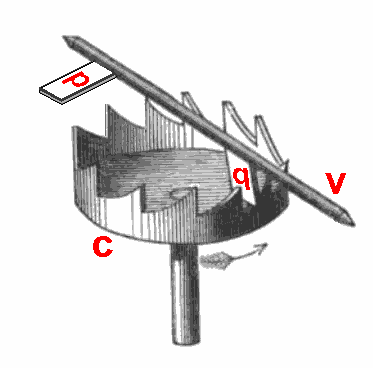
The spring detent escapement deserves special mention. Developed by Pierre Le Roy, John Arnold and Thomas Earnshaw, it gave the balance only one impulse per oscillation and required no oil at the impulse face. In a marine chronometer, sitting in gimbals in a padded box, it was unmatched, and it remained the standard for navigation until radio time signals and quartz made the marine chronometer obsolete. In a pocket watch, however, a sudden movement could cause the detent to trip and the watch to gain or stop. The lever, by contrast, was safe: its guard pin and safety roller prevent the lever from moving unless the balance is in the right position.
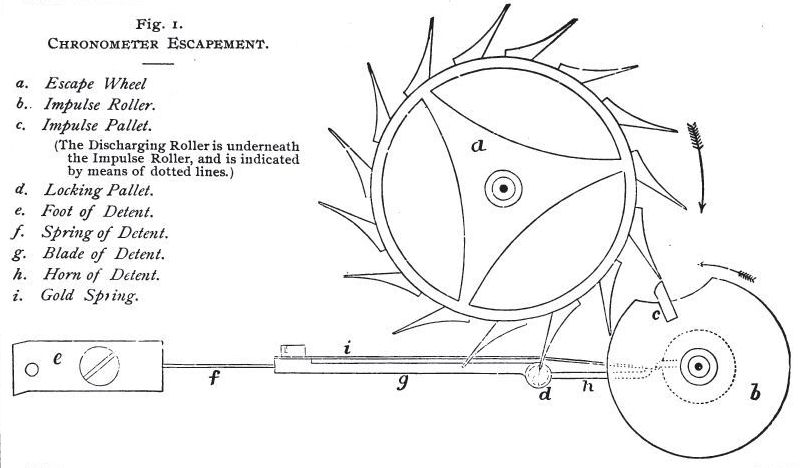
The English and Swiss levers
In the early nineteenth century English makers adopted the lever in the form now called the English or ratchet-tooth lever, in which the escape wheel has pointed teeth and all the impulse is given by the pallets. Swiss makers developed the club-tooth lever, dividing the impulse between inclined faces on the pallet stones and on the tips of the wheel teeth. The club-tooth form proved more tolerant of wear and of oil thickening; by the late nineteenth century the Swiss lever had become the international norm, and it remains so.
- Lock — the overlap between escape-wheel tooth and pallet that holds the train at rest.
- Draw — the angle of the locking face that pulls the lever against its banking, keeping it safe.
- Impulse — the push given to the balance as tooth and pallet slide past each other.
- Drop — the small free movement of the escape wheel after each impulse, before the next lock.
- Banking — the stops that limit the lever's travel.
Machines make the lever
What finally made the lever universal was manufacturing. In the 1850s the American Waltham Watch Company and its predecessors set out to make watches with machine-made, interchangeable parts. Their machinery could cut escape wheels and pallets to consistent tolerances in quantity, and the lever was the obvious escapement to standardise on. At the 1876 Philadelphia Centennial Exhibition the Waltham display astonished Swiss observers, prompting a reorganisation of Swiss production along industrial lines. Within a few decades, the cheap cylinder watch survived only at the bottom of the market; everything else was a lever.

The twentieth century refined rather than replaced the lever. Shock-protection systems guarded the balance pivots; new alloys made hairsprings resistant to temperature and magnetism; synthetic rubies became cheap enough for every pallet; and frequencies rose from 18,000 vibrations per hour to 28,800 and, in some calibres, 36,000. Pin-pallet levers, with steel pins instead of jewels, brought the principle to inexpensive alarm clocks and watches.
| Frequency | Beats per second | Typical use |
|---|---|---|
| 18,000 vph (2.5 Hz) | 5 | Many vintage watches; Omega 321; American railroad watches |
| 21,600 vph (3 Hz) | 6 | Mid-century and some modern calibres |
| 28,800 vph (4 Hz) | 8 | Most modern Swiss automatics (e.g. ETA 2824-2, Valjoux 7750) |
| 36,000 vph (5 Hz) | 10 | High-beat chronographs |
Challengers
The lever's remaining weakness is the sliding friction between tooth and pallet during impulse, which requires lubrication; as oil ages, amplitude falls and timekeeping drifts. The English watchmaker George Daniels devised the co-axial escapement in the 1970s to reduce that sliding by delivering impulse more directly. After long development, Omega brought it into serial production in 1999. Silicon escape wheels and pallets, introduced from the mid-2000s, attack the same problem from the side of materials. Both are, in a sense, descendants of the lever — and both confirm how hard it has been to improve on.

Reading a lever escapement
For a collector, recognising the type of lever is often the first step in dating and attributing a movement. English levers, common from about the 1820s to the early twentieth century, usually have a pointed-tooth escape wheel, often a fusee, and frequently a three-quarter plate with the balance cock on top. Swiss club-tooth levers have escape-wheel teeth with broad, angled tips. In inexpensive Swiss and German work, a pin-pallet lever with steel pins rather than jewelled pallets is common. American watches of the railroad era almost invariably use a jewelled club-tooth lever, adjusted to temperature and several positions for time-service grades.
The Identification Centre's decision tree walks through these clues step by step. As always, these observations narrow the possibilities rather than establishing an attribution; documented makers' records, serial ranges and hallmarks carry more weight than any single technical feature.
Why the lever won
- Detachment: the balance swings freely for most of its arc, so the hairspring governs the rate.
- Safety: guard pin and safety roller make it robust in a pocket or on a wrist.
- Self-starting: a lever watch starts when wound, unlike many detent watches.
- Manufacturability: once machine tools existed, its parts could be made precisely and cheaply.
- Adaptability: it scaled from marine deck watches to ladies' wristwatches, from jewelled chronometers to pin-pallet alarm clocks.
Mudge had the right idea in 1755. It took Swiss refinement, American machinery and a century of incremental improvement to prove it. To follow the story through the catalogue, start with the lever escapement entry, then the balance spring and detent escapement entries, and the profile of Thomas Mudge.
Sources & further reading
- Watchmaking — George Daniels, Sotheby Publications, 1981.
- Practical Watch Repairing — Donald de Carle, N.A.G. Press, 1946.
- Old Clocks and Watches and Their Makers — F. J. Britten, B. T. Batsford (London), 1899 (first edition).