Horological History · Historical feature
Clocks Before Europe: Kaifeng, Diyarbakır and the Long Prehistory of the Escapement
A century apart, a Song-dynasty statesman and an Artuqid court engineer documented regulated time machines of remarkable sophistication. Why are they so often missing from the story?
Atlas Editorial ·
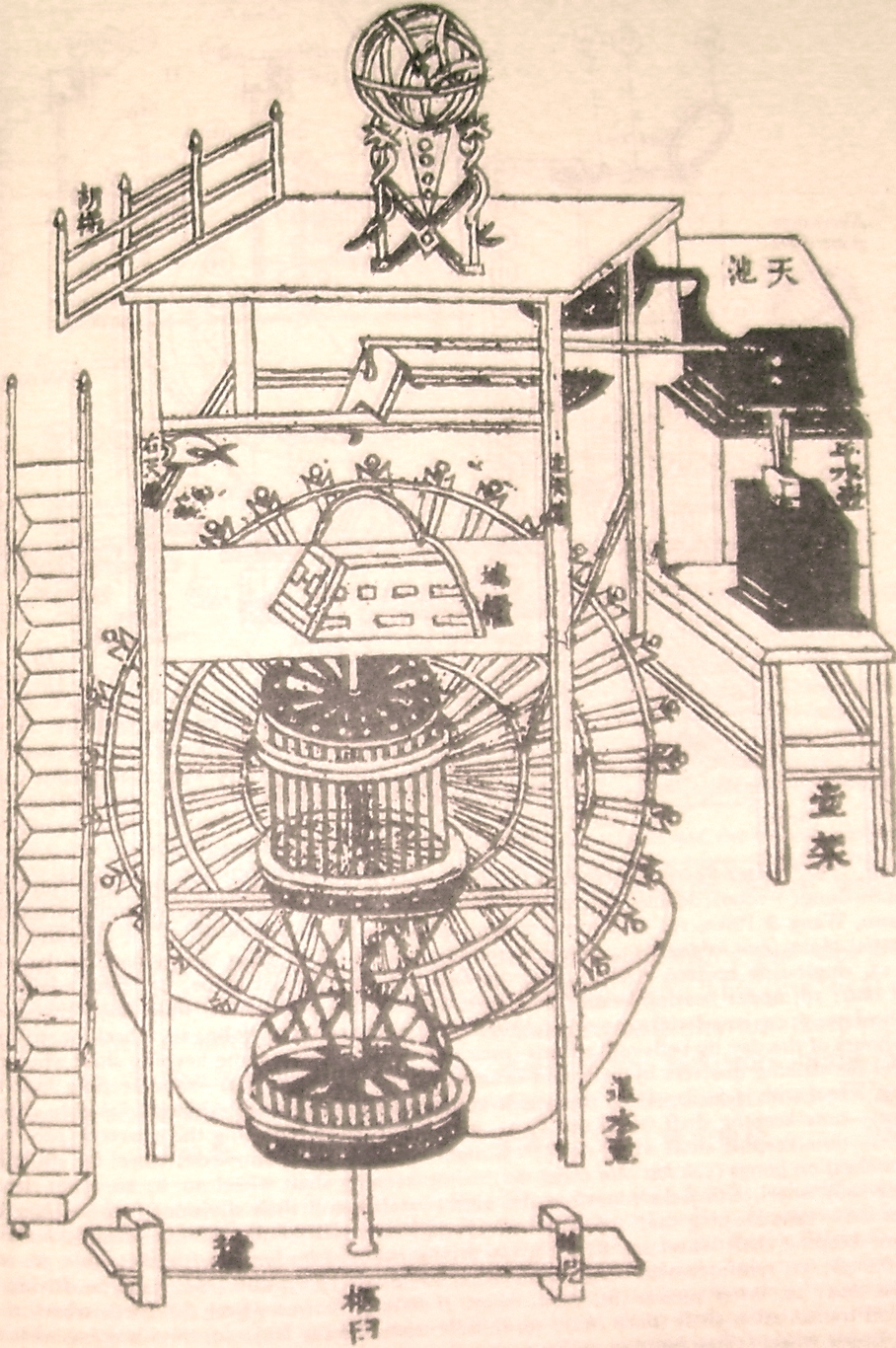
Su Song · Public domain · source
Most popular histories of horology open in a European bell tower some time around 1300. A heavy weight descends on a rope, a crown wheel turns, a verge rocks back and forth, and for the first time a machine divides the day into equal mechanical steps. It is a powerful story, and in its own terms an accurate one: the weight-driven verge clock is the direct ancestor of every mechanical clock and watch that followed. But it is not the beginning of the problem it solved. For more than two thousand years before that bell tower, engineers in Egypt, Mesopotamia, Greece, India, Persia and China had wrestled with the same question — how to make a physical process run at a steady, countable rate — and some of their answers were extraordinarily refined.
This feature looks at two of the best-documented of those answers: the astronomical clock tower completed under Su Song at the Song imperial capital of Kaifeng around 1092, and the water clocks described by Ismail al-Jazari at the Artuqid court in 1206. Neither machine survives. Both survive in text and drawings detailed enough that modern engineers have built working reconstructions. And both raise a question that a responsible encyclopedia has to answer carefully: what, exactly, is their relationship to the European mechanical clock?
The problem of regulation
Any timekeeper needs two things: a source of power and a way of releasing that power at a constant rate. Sundials sidestep the problem by reading the sky directly, but they fail at night and under cloud and their 'hours' changed length with the seasons. The outflow water clock — a vessel with a small hole near its base — provides continuous power from gravity, but the rate of flow falls as the water level drops. Ancient engineers knew this and compensated in two ways: by shaping vessels so that the falling level tracked time more evenly, and, from the Hellenistic period onward, by feeding the clock from a constant-head tank whose level was held steady by a float valve, an idea associated with Ctesibius of Alexandria in the third century BCE.
These were continuous regulators. What makes the later medieval machines interesting is that they introduce something closer to an escapement: a device that lets the driving power advance the mechanism in discrete, equal steps, checked after each step until a fixed quantity of something — water, in these cases — has accumulated.
Kaifeng, 1092: Su Song's tower
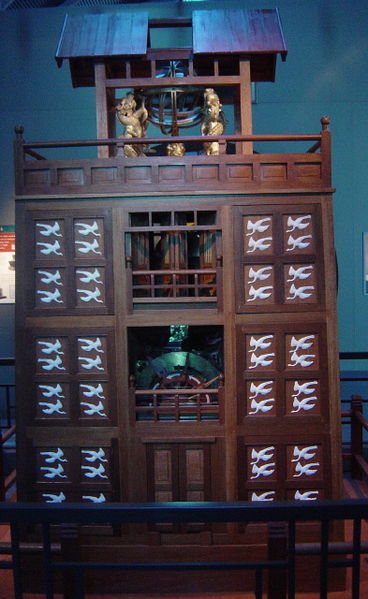
Su Song (1020–1101) was a senior official of the Northern Song state, a diplomat, pharmacologist and astronomer. In the 1080s he was commissioned to build a new astronomical instrument for the court, working with the mathematician and engineer Han Gonglian. The result, completed around 1092 and described in Su Song's treatise Xin Yixiang Fayao (New Design for an Armillary Clock), was a timber tower roughly twelve metres tall. At its summit stood a bronze armillary sphere for observation; inside, a celestial globe rotated in step with the heavens; and on the front a five-storey pagoda of doors presented figures that announced the hours and the quarters with bells, gongs and drums.
All of this was driven by a large water-wheel fitted with buckets around its rim. Water poured into one bucket at a steady rate from a constant-level tank. The wheel was held still by a system of levers and a counterweighted check; only when the bucket had filled to a set weight did it trip the linkwork, allowing the wheel to advance by one bucket before being stopped again. The motion was therefore intermittent and governed by a fixed quantity of water — the essential behaviour of an escapement, achieved with hydraulics rather than an oscillating mass.
| Feature | Description | Evidence |
|---|---|---|
| Date | Completed c. 1088–1092 | Documented in the Xin Yixiang Fayao |
| Height | About 12 m (timber) | Text and diagrams; dimensions interpreted by modern scholars |
| Power | Water-wheel with buckets, constant-head supply | Documented |
| Regulation | Weighing-lever check releasing one bucket at a time | Documented; mechanism reconstructed |
| Outputs | Armillary sphere, celestial globe, time-announcing figures | Documented |
| Transmission | Includes an endless chain drive | Documented; often cited as an early chain drive |
| Fate | Dismantled after the Jin capture of Kaifeng (1127) | Historical record |
The tower did not last. When Jurchen forces took Kaifeng in 1127, the machine was carried away and could not be made to work again; later attempts to rebuild it foundered on the loss of expertise. What survived was the book, which preserved enough detail for twentieth-century scholars — above all Joseph Needham, Wang Ling and Derek de Solla Price in their 1960 study Heavenly Clockwork — to reconstruct the mechanism and argue for its place in the history of the escapement.
Diyarbakır, 1206: al-Jazari's Book of Knowledge
Ismail ibn al-Razzaz al-Jazari served the Artuqid rulers of Diyarbakır in upper Mesopotamia, in what is now south-eastern Turkey. In 1206 he completed a treatise usually known in English as The Book of Knowledge of Ingenious Mechanical Devices. It describes some fifty machines in six categories — clocks, vessels and figures for entertainment, pitchers and basins, fountains, water-raising machines and miscellaneous devices — and, unusually for the period, it explains how to build them, with drawings, dimensions and materials.
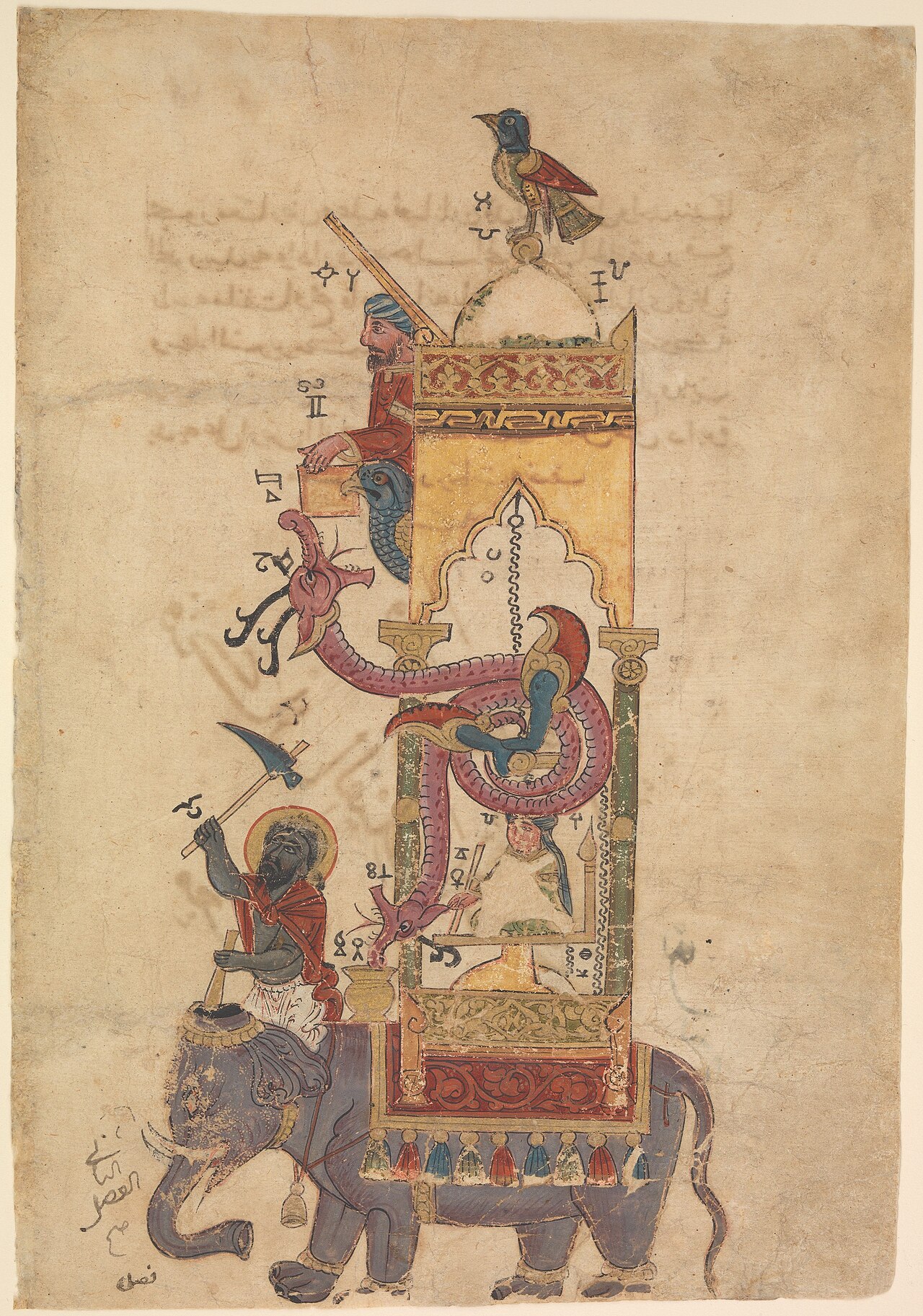
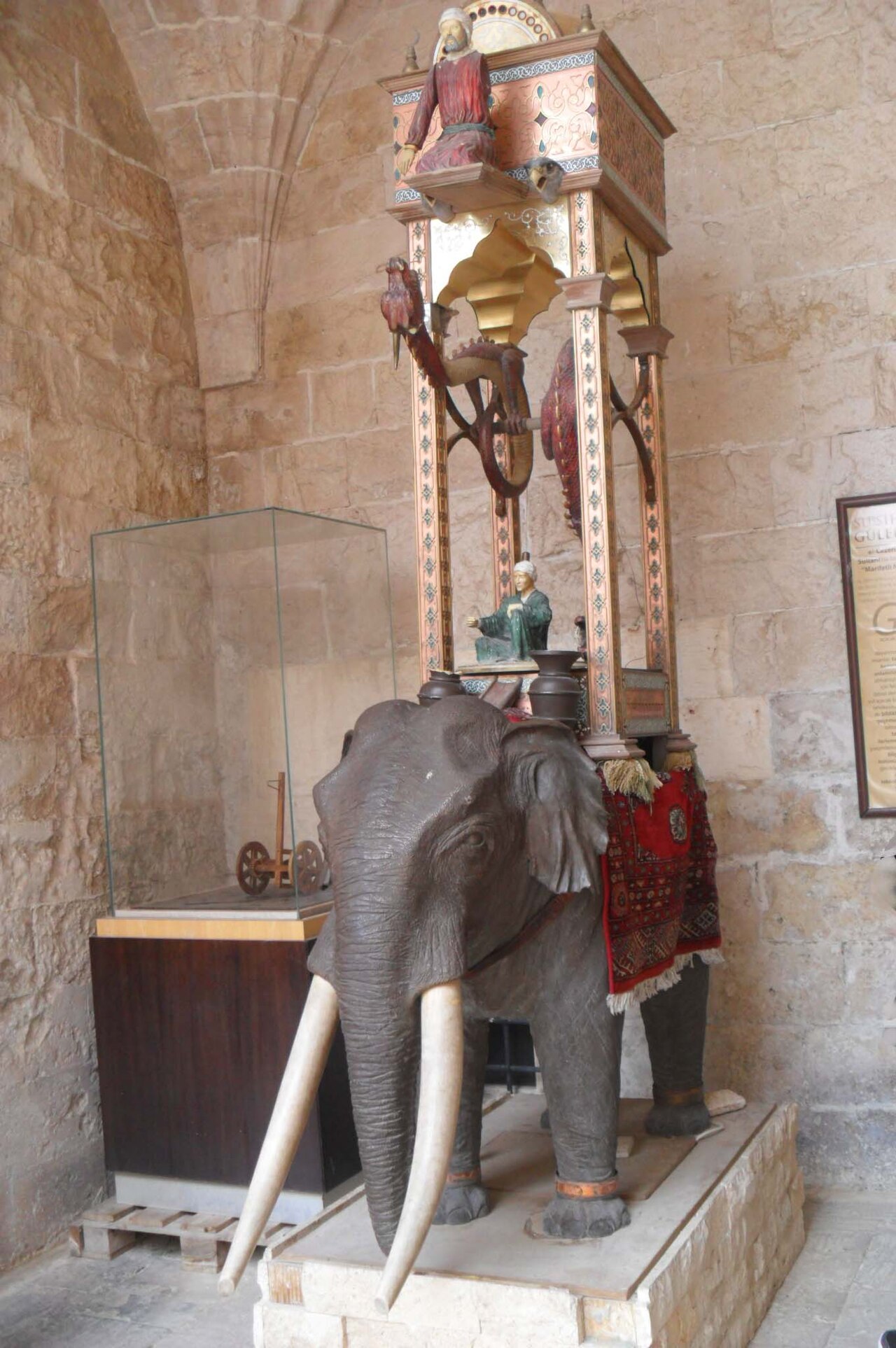
The most celebrated device is the elephant clock. Inside the elephant's body sits a water tank in which a perforated bowl floats and slowly sinks over half an hour. As it sinks it pulls on strings that, at the moment of submersion, release a ball from the castle on the elephant's back; the ball triggers a cascade of moving figures — a bird whistles, a scribe's pen turns, a mahout strikes a drum — and the bowl is pulled upright to begin again. The device is a timer with a self-resetting cycle, and al-Jazari presents it as an emblem of the cultures that contributed to his craft, combining an Indian elephant, a Persian carpet, Egyptian and Greek hydraulic principles and a Chinese dragon.
- The castle clock: a large water clock with zodiac display, moving doors and musicians, regulated by a float and a constant-flow arrangement.
- Candle clocks: candles of known burn rate whose descent, measured by a weighted mechanism, released balls to mark hours.
- Water-raising machines: including a double-acting pump with a crank-like conversion of rotary to reciprocating motion, much discussed by historians of technology.
- Programmable automata: musical figures whose sequence could be changed by rearranging pegs on a rotating drum.
What connects them to Europe?
Here the Atlas has to be precise. It is tempting to draw an arrow from Kaifeng or Diyarbakır to the first European verge clocks, and some popular accounts do so. The evidence does not support a documented line of transmission. The European verge-and-foliot escapement works on a different principle — an oscillating inertial mass alternately blocking and releasing a toothed wheel — and appears in the late thirteenth century in a context of monastic timekeeping, astronomical modelling and bell-ringing. Knowledge certainly moved between the Islamic world and Latin Europe, particularly through Iberia, and Arabic and Hebrew texts on water clocks and automata were known in Castile in the thirteenth century. But no surviving source shows a European clockmaker adapting Su Song's linkwork or al-Jazari's mechanisms.
A comparison
| Su Song (1092) | al-Jazari (1206) | European verge clock (c. 1300) | |
|---|---|---|---|
| Power source | Falling water on a wheel | Water flow; sinking float | Falling weight |
| Regulation | Weighed bucket released by linkwork | Constant-head flow; sinking bowl | Verge and foliot oscillator |
| Discrete steps? | Yes | Partly (cyclic reset) | Yes |
| Primary purpose | Astronomical modelling for the court | Display, entertainment, timekeeping | Ringing hours; astronomy |
| Survival | Text and drawings | Manuscripts | Fragments; later examples |
Why these machines matter
Restoring Kaifeng and Diyarbakır to the story is not about awarding priority. It changes how we understand what a clock is. In both cases the time-telling function was inseparable from other purposes — astronomical calculation for a state that needed accurate calendars, or courtly display that communicated a ruler's command of knowledge. The same is true of the great European astronomical clocks, such as the Prague Orloj of 1410, whose dials show the sun, moon and zodiac more prominently than the hour. Seen together, they suggest that the mechanical clock emerged less from a desire to know the hour than from a desire to model the cosmos.
They also remind us how much depends on documentation. Su Song's tower and al-Jazari's clocks are known because their makers wrote books meant to be followed. Countless other devices from India, Persia, Byzantium and elsewhere are known only from passing references. An encyclopedia that wants to be global has to work with that unevenness honestly, distinguishing what is documented from what is inferred, rather than filling gaps with assumptions drawn from the better-recorded European story.
Where to see them today
- Folios from copies of al-Jazari's treatise are held by several institutions, including The Metropolitan Museum of Art, New York, which has released images into the public domain.
- Working reconstructions of Su Song's tower have been built for museums in Taiwan, Japan and the United Kingdom, among others.
- Reconstructions of the elephant clock stand in public places and museums, including in Mardin and in the Ibn Battuta Mall, Dubai.
Key terms
- Clepsydra — a water clock that measures time by the regulated flow of water.
- Constant-head tank — a vessel kept at a steady level, so that outflow is uniform.
- Armillary sphere — an instrument of rings representing celestial circles.
- Automaton — a self-moving figure, often used to announce the hour.
- Verge and foliot — the earliest European mechanical escapement and its oscillating bar.
Explore the catalogue records for both machines, the encyclopedia entry on the verge escapement, and the medieval era page to follow these connections further. As with every record in the Atlas, corrections supported by sources are welcome.
Sources & further reading
- Heavenly Clockwork: The Great Astronomical Clocks of Medieval China — Joseph Needham, Wang Ling, Derek J. de Solla Price, Cambridge University Press, 1960.
- The Book of Knowledge of Ingenious Mechanical Devices — Ibn al-Razzaz al-Jazari, trans. Donald R. Hill, D. Reidel, 1974 (translation).
- Revolution in Time: Clocks and the Making of the Modern World — David S. Landes, Harvard University Press, 1983.