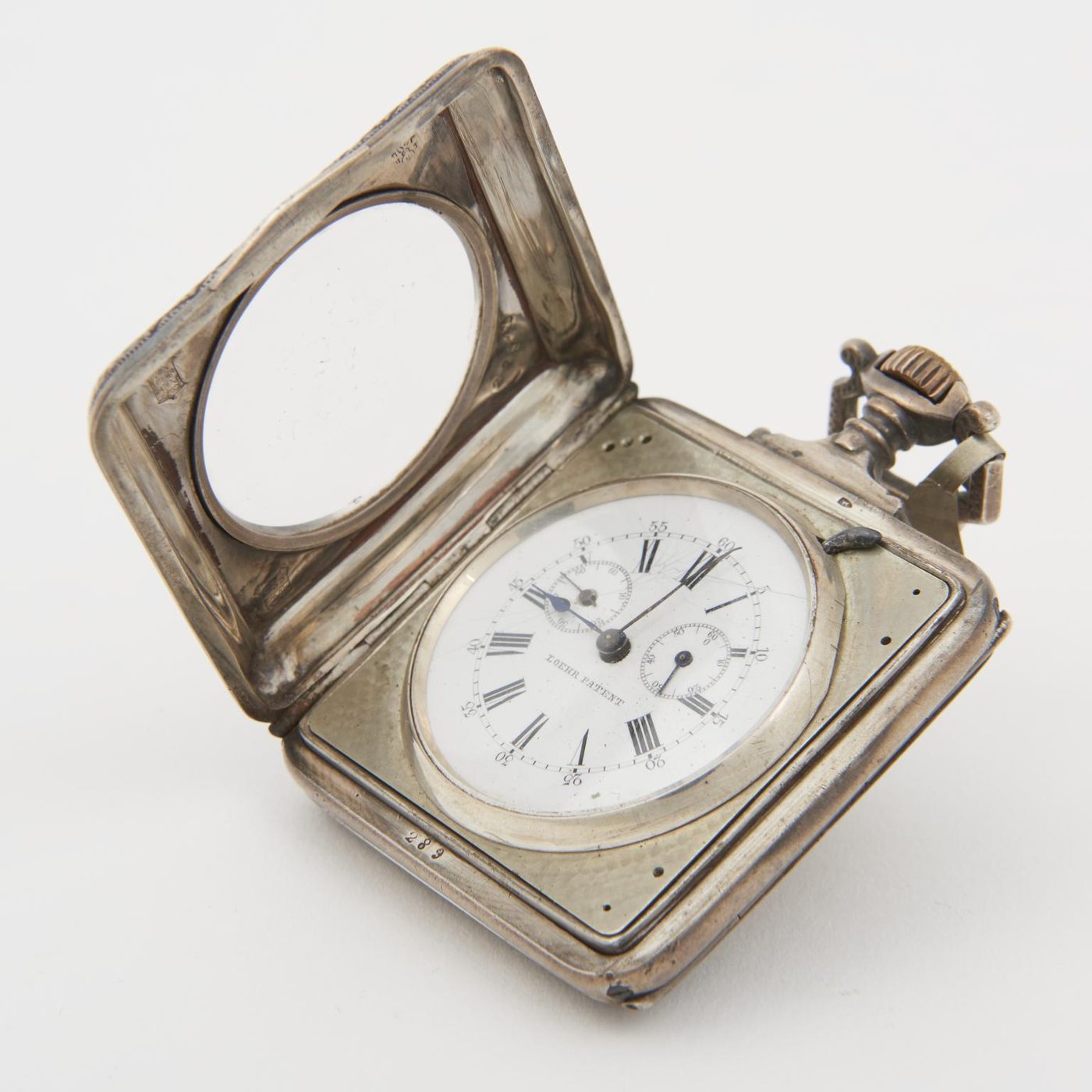
Wristwatches · Wrist-watch; self-winding watch; pocket watch
Wristwatch by Loehr, Austria, 1875-1885
- Maker / attribution
- Loehr (maker)
- Date
- 1875-1885
- Historical period
- Industrial Revolution (1850 – 1900)
- Country of origin
- Austria
- Place
- Vienna, Austria, Vienna
- Object type
- Wrist-watch; self-winding watch; pocket watch
- Dimensions
- overall: 16 mm x 50 mm x 61 mm, .115kg
- Holding institution
- Science Museum Group, London
- Accession / object no.
- 1963-164
- Catalogue title (original)
- Self winding pocket watch in square, silver case
Record summary
Held and catalogued by Science Museum Group, London (object number 1963-164), this is a wrist-watch; self-winding watch; pocket watch by Loehr, made in Vienna, Austria, Vienna, dated 1875-1885. The Atlas places it in the Industrial Revolution period (1850 – 1900) of its Wristwatches collection. Recorded dimensions: overall: 16 mm x 50 mm x 61 mm, .115kg. The record is illustrated with 4 photographs.
Assembled from the source record's structured fields. Dates and attributions are given as the source states them; where a field is missing the Atlas leaves it blank rather than estimating.
Catalogue description
The source record does not include a narrative description. The structured fields above are reproduced from it.
Inscriptions & marks
; ;
Historical context
Industrial Revolution (1850 – 1900)
American interchangeable-parts manufacture; railroad time standards; Swiss and German factory systems.
Wristlets for women and early military wristlets — small pocket watch movements in cases with wire lugs — appeared towards the end of the century.
Read the period in the timelineMore wristwatches from this periodEarlier: Precision & Scientific Horology
Atlas type guide
Automatic (self-winding) watches
Self-winding watches use the wearer's motion to wind the mainspring. Abraham-Louis Perrelet and Breguet made 'perpétuelle' pocket watches with oscillating weights in the late eighteenth century, but the principle only became practical in the wristwatch. John Harwood patented a bumper automatic in 1923; Rolex's Perpetual rotor (1931) winding in one direction, and later bidirectional rotors (Eterna, Felsa Bidynator), established the modern form. Micro-rotors (Universal Genève, Buren) and peripheral rotors made automatic watches thinner.
What to look for
- A semicircular rotor turning 360° over the movement, or a 'bumper' weight that rebounds between springs.
- 'Automatic', 'Perpetual' or 'Self-winding' on the dial.
- A sealed screw-back case, since automatic watches are wound less often by the crown.
Dating clues
- Bumper automatics: 1923–c. 1955.
- Full rotors: from 1931 (Rolex); widespread after c. 1950.
- Micro-rotors: from 1954–1958.
General guidance written by the Atlas editors about this kind of object. It is not a statement about this particular piece; for that, rely on the source record above and on physical examination.