Instruments · Sundial
Sundial, Wildegg, 1956 BCE
- Maker / attribution
- Unrecorded in source
- Date
- 1956 BCE
- Historical period
- Ancient Civilizations (Before 500 BCE)
- Country of origin
- Unrecorded in source
- Place
- Wildegg
- Object type
- Sundial
- Holding institution
- Museum Aargau
- Accession / object no.
- _kimnet_cho_6682962e_4396_0d16_4b81_4eb961ac7a1c
- Catalogue title (original)
- Sonnenuhr (German)
Record summary
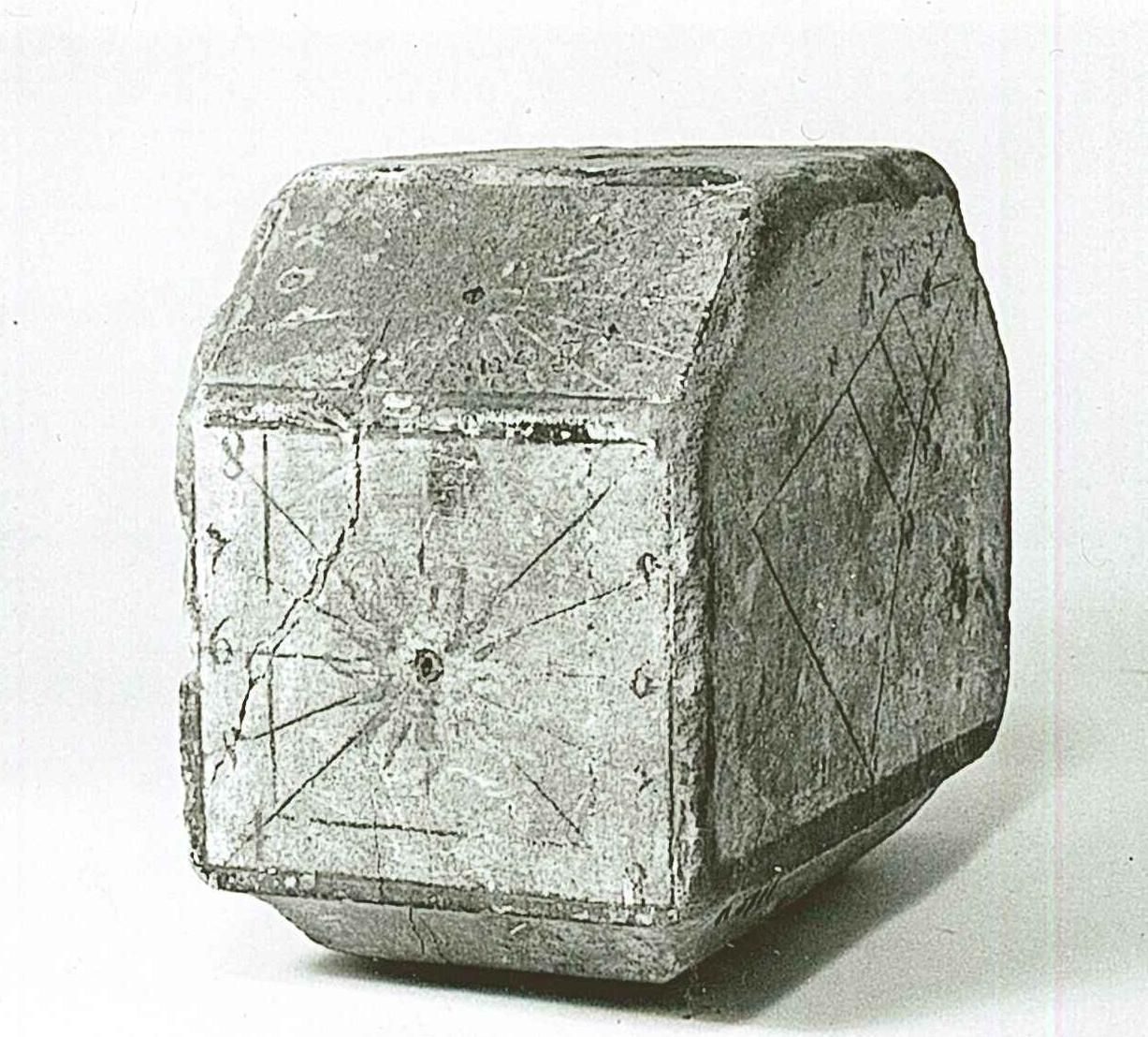
Held and catalogued by Museum Aargau (object number _kimnet_cho_6682962e_4396_0d16_4b81_4eb961ac7a1c), this is a sundial, made in Wildegg, dated 1956 BCE. The Atlas places it in the Ancient Civilizations period (Before 500 BCE) of its Instruments collection. The record is illustrated with 1 photograph.
Assembled from the source record's structured fields. Dates and attributions are given as the source states them; where a field is missing the Atlas leaves it blank rather than estimating.
Catalogue description
Catalogue description from Museum Aargau (German)
Die Sonnenuhr ist eine der ältesten bekannten Methoden der Zeitmessung und kann bis auf das zweite Jahrtausend v. Chr. zurückverfolgt werden. Während die Grundtechnik an sich sehr simpel ist und nicht mehr als einen Stock benötigt, um dessen wandernden Schatten zu beobachten, so erfordern genauere Messungen schon etwas komplexere Lösungen. Denn im Verlauf des Jahres ändert sich die Position der Sonne und die Dauer eines Tages und auch je nach Breitengrad muss die Position des Schattenwerfers neu eingestellt werden. Eine mögliche Lösung für solche komplexeren Probleme zeigt dieses Objekt, eine mehrseitige Sonnenuhr aus Sandstein. Solche mehrseitigen Sonnenuhren boten mitunter die Gelegenheit, gleichzeitig sowohl die Uhrzeit als auch die Neigung der Sonneneinstrahlung zu messen oder verschiedene Zeitzonen anzuzeigen. Der genaue Zweck und das Alter dieses spezifischen Exemplars sind leider nicht bekannt. Es gehörte zum Inventar der Lenzburg und kam 1956 in den Besitz der Stiftung Schloss Lenzburg.
Shown in the original language of the source catalogue. An editor-reviewed English translation has not yet been published; we do not publish machine translations as authoritative text.
Historical context
Ancient Civilizations (Before 500 BCE)
Shadow clocks, sundials and outflow water clocks in Egypt, Mesopotamia and China divide day and night into hours.
The earliest instruments for measuring time used the sun and water: Egyptian shadow clocks, sundials and outflow water clocks.
Read the period in the timelineMore instruments from this period
Atlas type guide
Sundials and solar time-finders
A sundial tells time from the position of a shadow cast by a gnomon or style. Because the sun's apparent motion depends on latitude, every fixed dial is laid out for a particular latitude, and portable dials either carry a latitude scale or are made for one region. Sundials show local apparent solar time, which drifts against mean (clock) time by up to about sixteen minutes over the year — the equation of time.
Portable dials were the pocket instruments of the sixteenth to eighteenth centuries. Nuremberg and Augsburg workshops produced folding ivory diptych dials with inset compasses; English and French makers sold brass horizontal dials, ring dials and the Butterfield type; Japanese and Chinese makers had their own traditions of compass dials. After mechanical watches became reliable, dials remained in use for setting them, and nineteenth-century heliochronometers were built to correct directly for the equation of time.
What to look for
- The latitude engraved on the dial plate or a latitude arc on the gnomon — it shows where the dial was meant to be used.
- The type of hour lines: equal (equinoctial) hours, Italian or Babylonian hours counted from sunset or sunrise, or unequal temporal hours on early and Islamic instruments.
- An inset magnetic compass and whether a magnetic-declination mark is drawn on its card — a useful dating clue because declination changes over time.
- Maker's signatures and town marks: Nuremberg compass-makers (Kompassmacher) often struck a personal mark and the town's punch.
- Additional scales such as lunar volvelles, wind roses, perpetual calendars or lists of cities with their latitudes.
Dating clues
- Ivory diptych dials are characteristic of Nuremberg between about 1500 and 1700.
- Butterfield-type dials with a bird-shaped adjustable gnomon point to Paris workshops from the late seventeenth century onward.
- Equation-of-time tables engraved on the plate became common after the mid-seventeenth century, once pendulum clocks made the difference between solar and mean time obvious.
General guidance written by the Atlas editors about this kind of object. It is not a statement about this particular piece; for that, rely on the source record above and on physical examination.
Read next:The history timeline