Instruments · Sundial; moondial
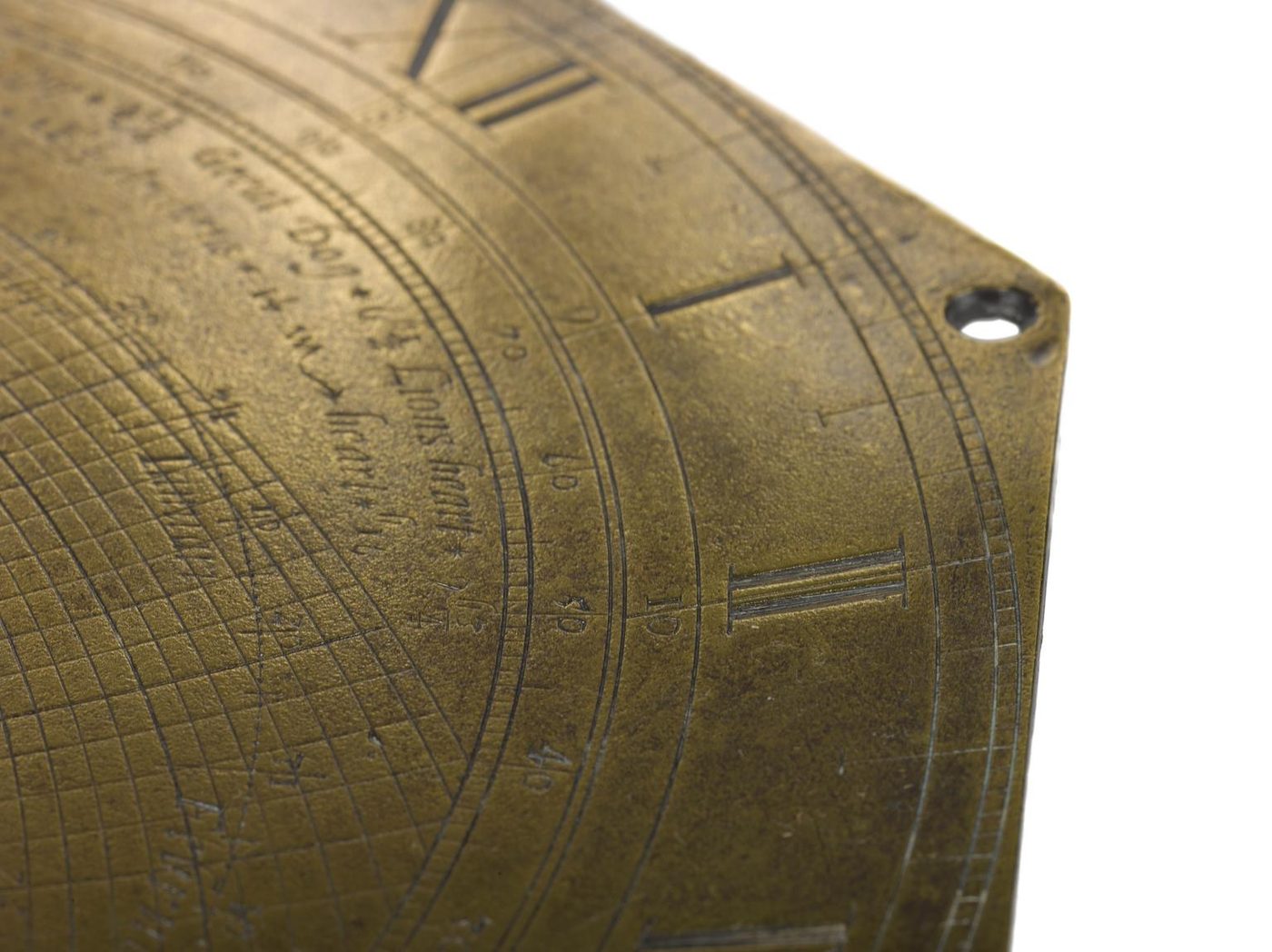
Sundial by Allen, Elias, England, 1607-1653
- Maker / attribution
- Allen, Elias (maker); Elias Allen (maker)
- Date
- 1607-1653
- Historical period
- Early Modern Horology (1600 – 1750)
- Country of origin
- England
- Place
- London, Greater London, England, United Kingdom, London
- Object type
- Sundial; moondial
- Dimensions
- Overall: 140 mm x 258 mm x 258 mm, 1.1 kg
- Holding institution
- Science Museum Group, London
- Accession / object no.
- 1921-613
- Credit line
- Court, Thomas Henry
- Catalogue title (original)
- Sun-and-moon dial by Elias Allen
Record summary
Held and catalogued by Science Museum Group, London (object number 1921-613), this is a sundial; moondial by Allen, Elias, made in London, Greater London, England, United Kingdom, London, dated 1607-1653. The Atlas places it in the Early Modern Horology period (1600 – 1750) of its Instruments collection. Recorded dimensions: Overall: 140 mm x 258 mm x 258 mm, 1.1 kg. The record is illustrated with 4 photographs.
Assembled from the source record's structured fields. Dates and attributions are given as the source states them; where a field is missing the Atlas leaves it blank rather than estimating.
Catalogue description
Science Museum Group description
Sun-and-moon dials are time-reckoning devices that can be used in daylight as sundials and at night as moondials. This example was made by Elias Allen (active 1602-1653) at his workshop known as 'The Bull's Head' which was situated near St. Clement's Church, near the Strand in London. Allen was a mathematical instrument maker who moved to London from Tonbridge in Kent to take up an apprenticeship with Charles Whitwell in around 1602.
Historical context
Early Modern Horology (1600 – 1750)
Huygens' pendulum and balance spring transform accuracy; English makers develop the anchor and deadbeat escapements.
Pocket sundials, Butterfield dials and sandglasses remained essential companions to imperfect clocks; navigators used sandglasses and the log line; observatories began to combine telescopes with pendulum clocks.
Read the period in the timelineMore instruments from this periodEarlier: Renaissance Horology
Atlas type guide
Sundials and solar time-finders
A sundial tells time from the position of a shadow cast by a gnomon or style. Because the sun's apparent motion depends on latitude, every fixed dial is laid out for a particular latitude, and portable dials either carry a latitude scale or are made for one region. Sundials show local apparent solar time, which drifts against mean (clock) time by up to about sixteen minutes over the year — the equation of time.
Portable dials were the pocket instruments of the sixteenth to eighteenth centuries. Nuremberg and Augsburg workshops produced folding ivory diptych dials with inset compasses; English and French makers sold brass horizontal dials, ring dials and the Butterfield type; Japanese and Chinese makers had their own traditions of compass dials. After mechanical watches became reliable, dials remained in use for setting them, and nineteenth-century heliochronometers were built to correct directly for the equation of time.
What to look for
- The latitude engraved on the dial plate or a latitude arc on the gnomon — it shows where the dial was meant to be used.
- The type of hour lines: equal (equinoctial) hours, Italian or Babylonian hours counted from sunset or sunrise, or unequal temporal hours on early and Islamic instruments.
- An inset magnetic compass and whether a magnetic-declination mark is drawn on its card — a useful dating clue because declination changes over time.
- Maker's signatures and town marks: Nuremberg compass-makers (Kompassmacher) often struck a personal mark and the town's punch.
- Additional scales such as lunar volvelles, wind roses, perpetual calendars or lists of cities with their latitudes.
Dating clues
- Ivory diptych dials are characteristic of Nuremberg between about 1500 and 1700.
- Butterfield-type dials with a bird-shaped adjustable gnomon point to Paris workshops from the late seventeenth century onward.
- Equation-of-time tables engraved on the plate became common after the mid-seventeenth century, once pendulum clocks made the difference between solar and mean time obvious.
General guidance written by the Atlas editors about this kind of object. It is not a statement about this particular piece; for that, rely on the source record above and on physical examination.
Read next:The history timeline
Related records
Instruments · 1625-1635
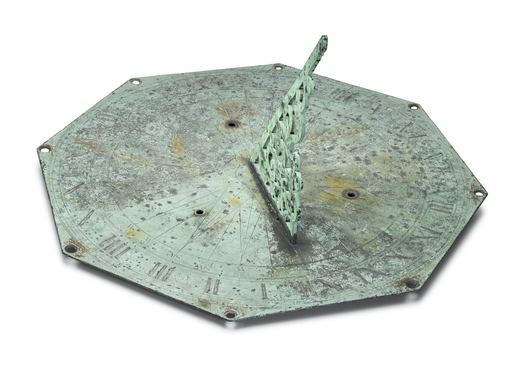
A very high quality horizontal sundial, set out to show individual minutes and signed ‘Elias Allen fecit’. London, c.1630
Science Museum Group, London
Instruments · 1630-1653
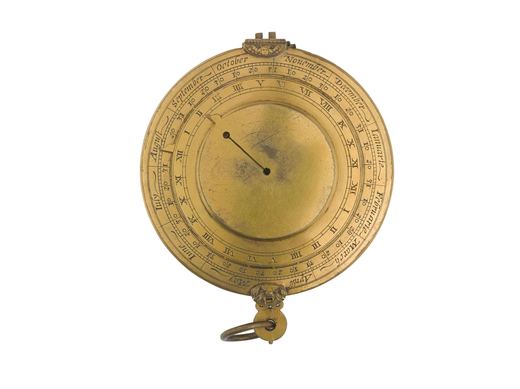
Sundial by Allen, Elias, England, 1630-1653
Science Museum Group, London
Instruments · 1623-1700
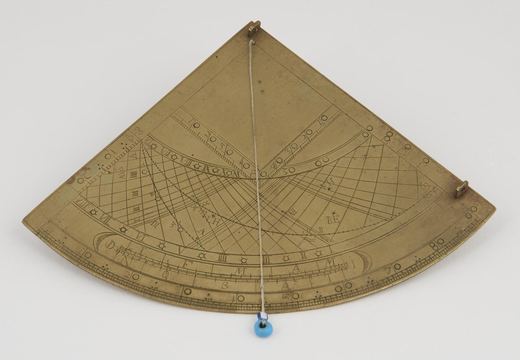
Armillary / astronomical instrument, England, 1623-1700
Science Museum Group, London
Instruments · 1636-1700
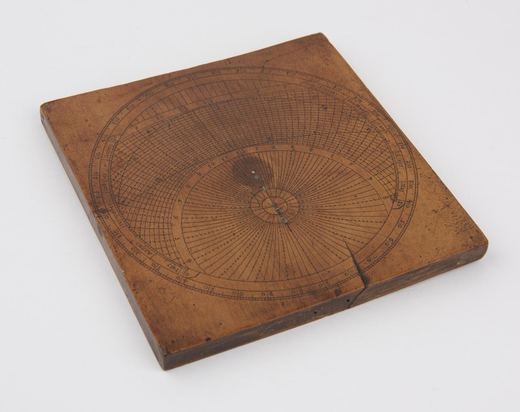
Sundial incomplete: gnomon missing: wood, 5" square, 1636-1700
Science Museum Group, London
Instruments · 1650-1665
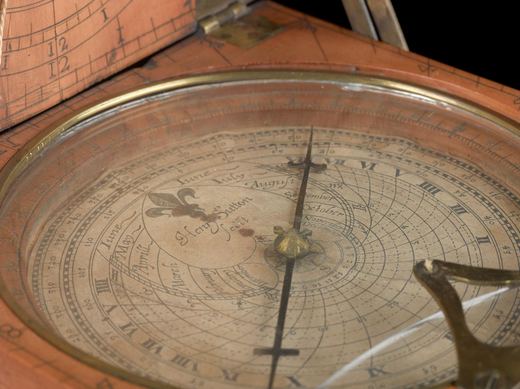
Folding pocket compass and sundial in boxwood case made by Henry Sutton, Threadneedle Street, London, 1650-1665.
Science Museum Group, London
Instruments · 1650-1749
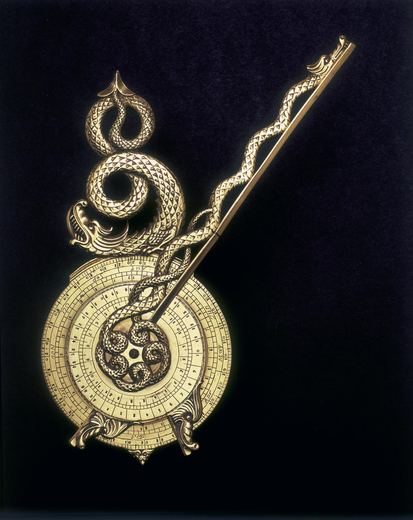
Nocturnal, brass, gilt, diameter of flanged plate 4 in. Handle and pointer in form of serpents, English, late 17th or 18th century with later case
Science Museum Group, London
Instruments · 1650–1699
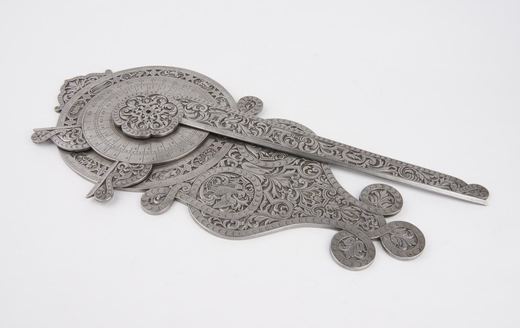
Nocturnal, iron, English late 17th century. (18-79) V & A M. register.
Science Museum Group, London
Instruments · 1680-1720
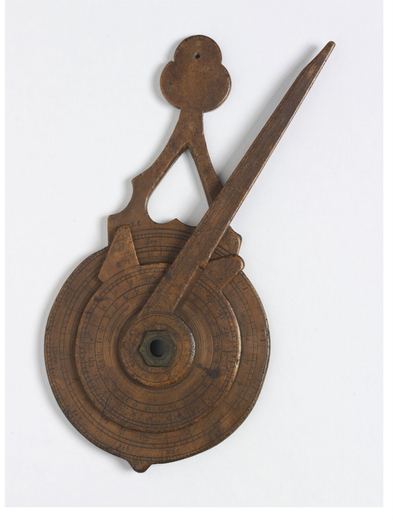
Engraved applewood nocturnal, a maritime device for telling the time at night from the stars. English, 1680-1720.
Victoria and Albert Museum, London