Pocket Watches · Pocket watch
Pocket watch, Strängnäs, 1873–2017
- Maker / attribution
- Unrecorded in source
- Date
- 1873–2017
- Historical period
- Modern Mechanical Horology (1945 – 1969)
- Country of origin
- Unrecorded in source
- Place
- Strängnäs
- Object type
- Pocket watch
- Holding institution
- Sörmland Museum
- Accession / object no.
- SLM_item_445117
- Catalogue title (original)
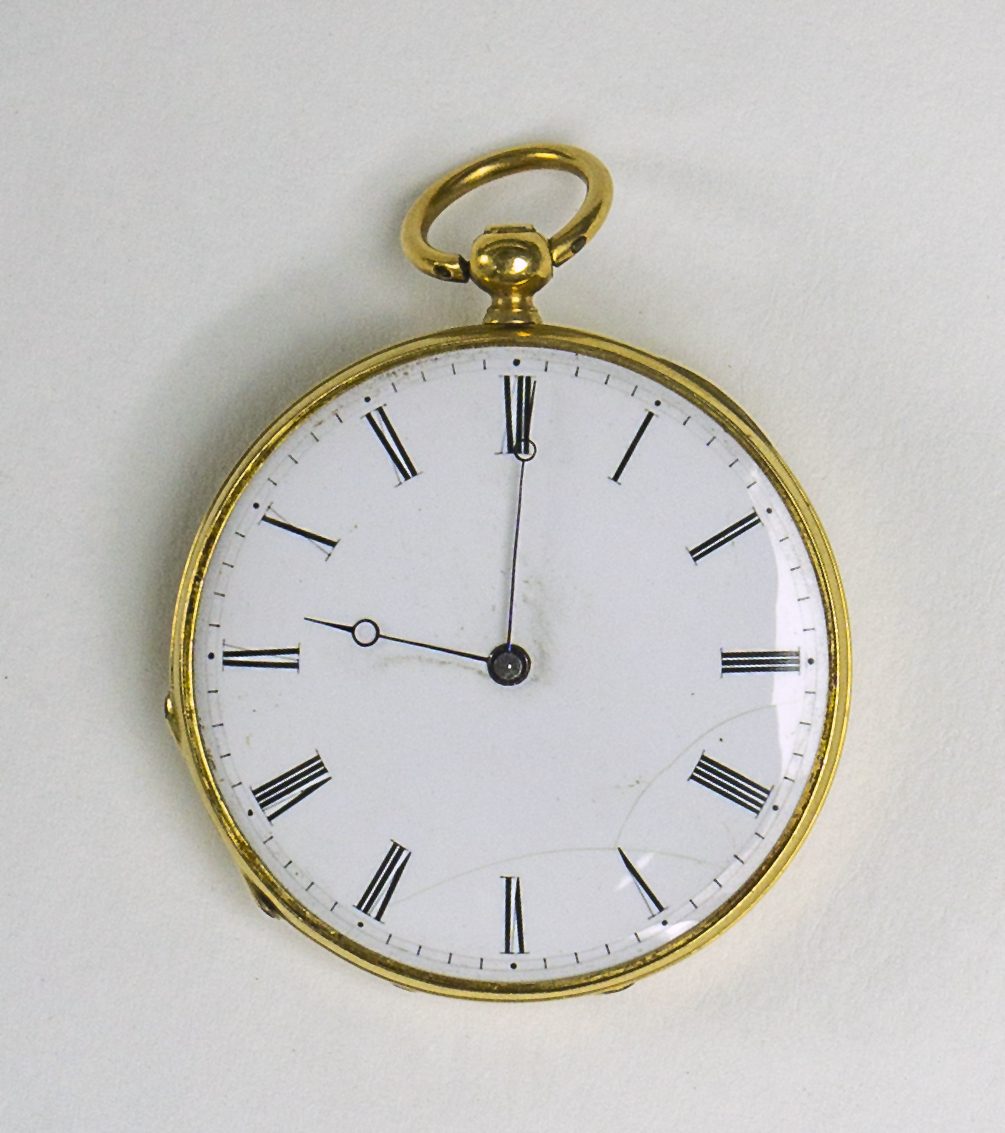
- Fickur av guld "Echappement à Cylindre, quatre rubis N 35717"
Record summary
Held and catalogued by Sörmland Museum (object number SLM_item_445117), this is a pocket watch, made in Strängnäs, dated 1873–2017. The Atlas places it in the Modern Mechanical Horology period (1945 – 1969) of its Pocket Watches collection. The record is illustrated with 1 photograph.
Assembled from the source record's structured fields. Dates and attributions are given as the source states them; where a field is missing the Atlas leaves it blank rather than estimating.
Catalogue description
Catalogue description from Sörmland Museum (Swedish)
Litet fickur av guld, fyra cm i diameter. Emaljerad vit urtavla med romerska siffror och enkla smala visare. Baksidan dekorerad med en vapensköld omgiven av svängt rutnät. Märkt på det inre locket: "Echappement à Cylindre quatre rubis N 35717" samt på själva urverket: "Avance Retard". Fickuret är en gåva av "prostinnan Ek" år 1960 till Strängnäs museum. Ester Emilia Charlotta Kjerrulf (född 14/3 1881 i Mölltorp, död 5/12 1975), gift 1904 med prosten och kyrkoherden Ernst Georg Ek (1873-1932) i Vansö. Efter makens död flyttade Ester till Strängnäs. Fickuret överfördes år 2017 till Sörmlands museum.
Shown in the original language of the source catalogue. An editor-reviewed English translation has not yet been published; we do not publish machine translations as authoritative text.
Historical context
Modern Mechanical Horology (1945 – 1969)
Tool watches for divers, pilots and astronauts; electric watches anticipate the electronic age.
After 1945 the pocket watch became a niche product — presentation and railway watches, inexpensive pin-lever watches, and commemorative pieces — while most innovation moved to the wrist.
Read the period in the timelineMore pocket watches from this periodEarlier: Golden Age of Mechanical Watchmaking
Atlas type guide
Pocket watches
The pocket watch was the dominant personal timekeeper from the late seventeenth century until the First World War. Its development tracks the history of the escapement: verge watches with fusees until the late eighteenth century; Thomas Mudge's lever escapement (c. 1755) and the cylinder escapement popularised by George Graham and later by Swiss makers; and the Swiss and English lever watches of the nineteenth century. Lépine's bar-bridge calibre and keyless winding made watches thinner and easier to use.
Industrialisation transformed the trade: American factories such as Waltham (from 1850) and Elgin produced interchangeable parts by machine, and Swiss makers responded with their own mechanisation after the 1876 Philadelphia Exhibition. By 1900 a reliable watch was affordable to millions; the finest makers continued to produce complications and precision watches.
What to look for
- The escapement: verge (crown wheel), cylinder, duplex, English or Swiss lever.
- Key winding (a square arbor in dial or back) or keyless crown winding.
- Signatures and serial numbers on the movement, dial and inside case back.
- Hallmarks, case maker's marks and gold or silver standards stamped in the case.
- Dial material: enamel, silver, gold, later printed metal.
Dating clues
- Verge watches dominate before c. 1800; cylinder watches c. 1770–1900; lever watches after c. 1820.
- Keyless winding: increasingly common after c. 1860.
- Manufacturer serial number lists exist for Waltham, Elgin, Longines, Omega, Patek Philippe and others.
General guidance written by the Atlas editors about this kind of object. It is not a statement about this particular piece; for that, rely on the source record above and on physical examination.
Read next:Verge escapementDetached lever escapementFuseeIdentification Centre
Related records
Pocket Watches · 1900–1999
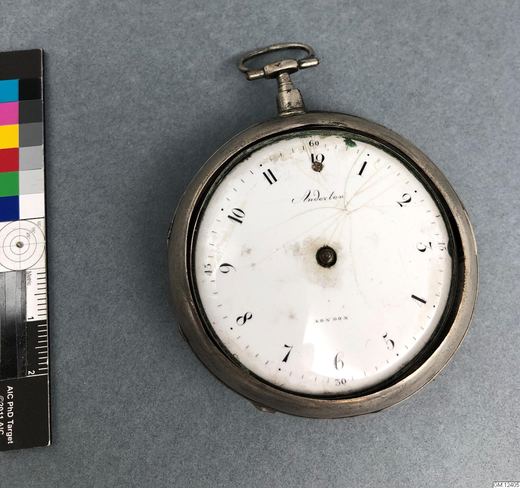
Pocket watch by Anderton, Halland, 1900–1999
Museum of Gothenburg
Pocket Watches · 1900–1999
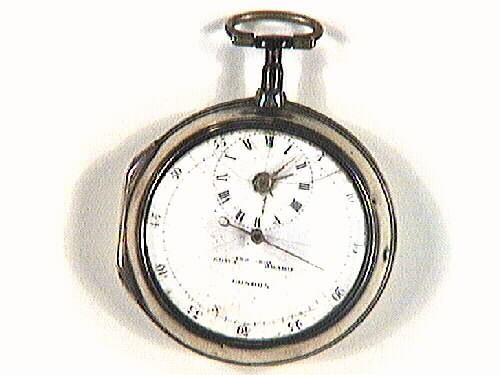
Pocket watch by Edward Howard [11:01], England, 1900–1999
Lake Vänern Museum
Pocket Watches · 1900–1999
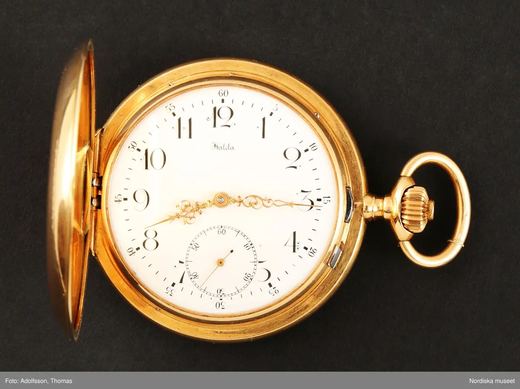
Pocket watch by Halda Fickurfabrik, Gothenburg, 1900–1999
Nordic Museum Foundation
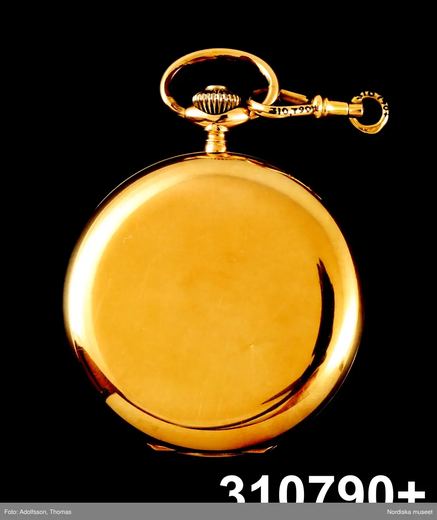
Pocket Watches · 1900–1999
Pocket watch by Jaen Wikander, Sweden, 1900–1999
Nordic Museum Foundation
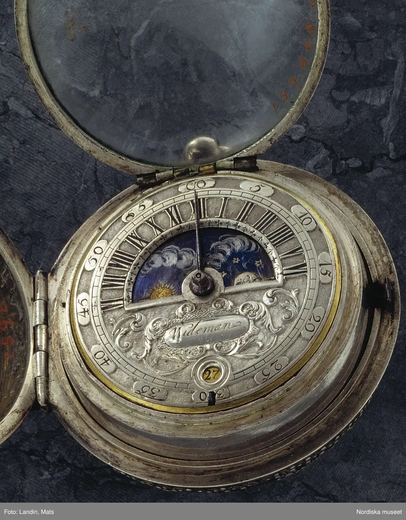
Pocket Watches · 1900–1999
Pocket watch by Mats Landin, Sweden, 1900–1999 (Nordic Museum Foundation nomu_photo_NMA0027711)
Nordic Museum Foundation
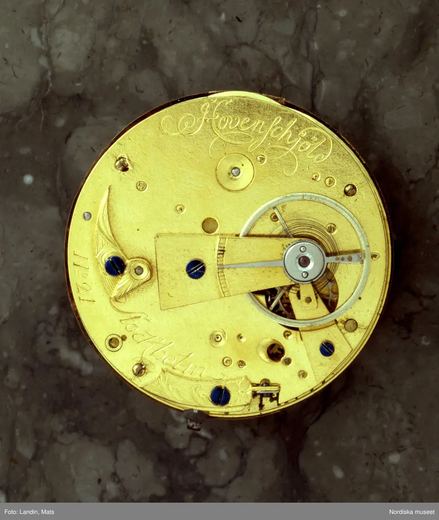
Pocket Watches · 1900–1999
Pocket watch by Mats Landin, Sweden, 1900–1999 (Nordic Museum Foundation nomu_photo_NMA0060040)
Nordic Museum Foundation
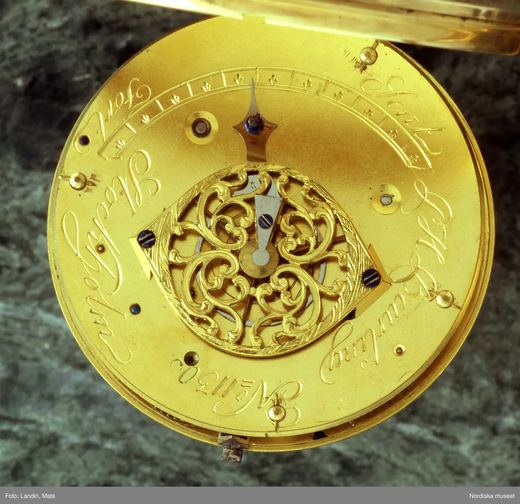
Pocket Watches · 1900–1999
Pocket watch by Mats Landin, Sweden, 1900–1999 (Nordic Museum Foundation nomu_photo_NMA0060041)
Nordic Museum Foundation
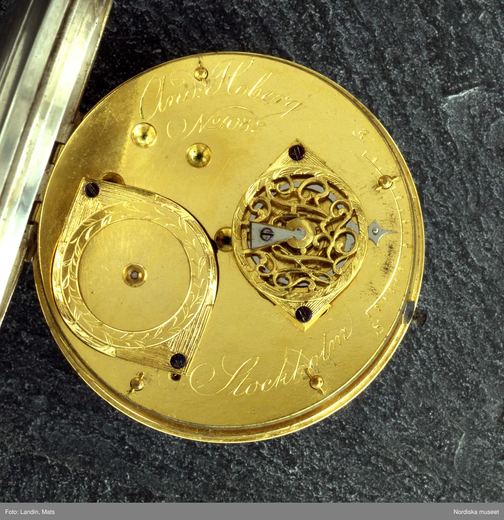
Pocket Watches · 1900–1999
Pocket watch by Mats Landin, Sweden, 1900–1999 (Nordic Museum Foundation nomu_photo_NMA0060043)
Nordic Museum Foundation