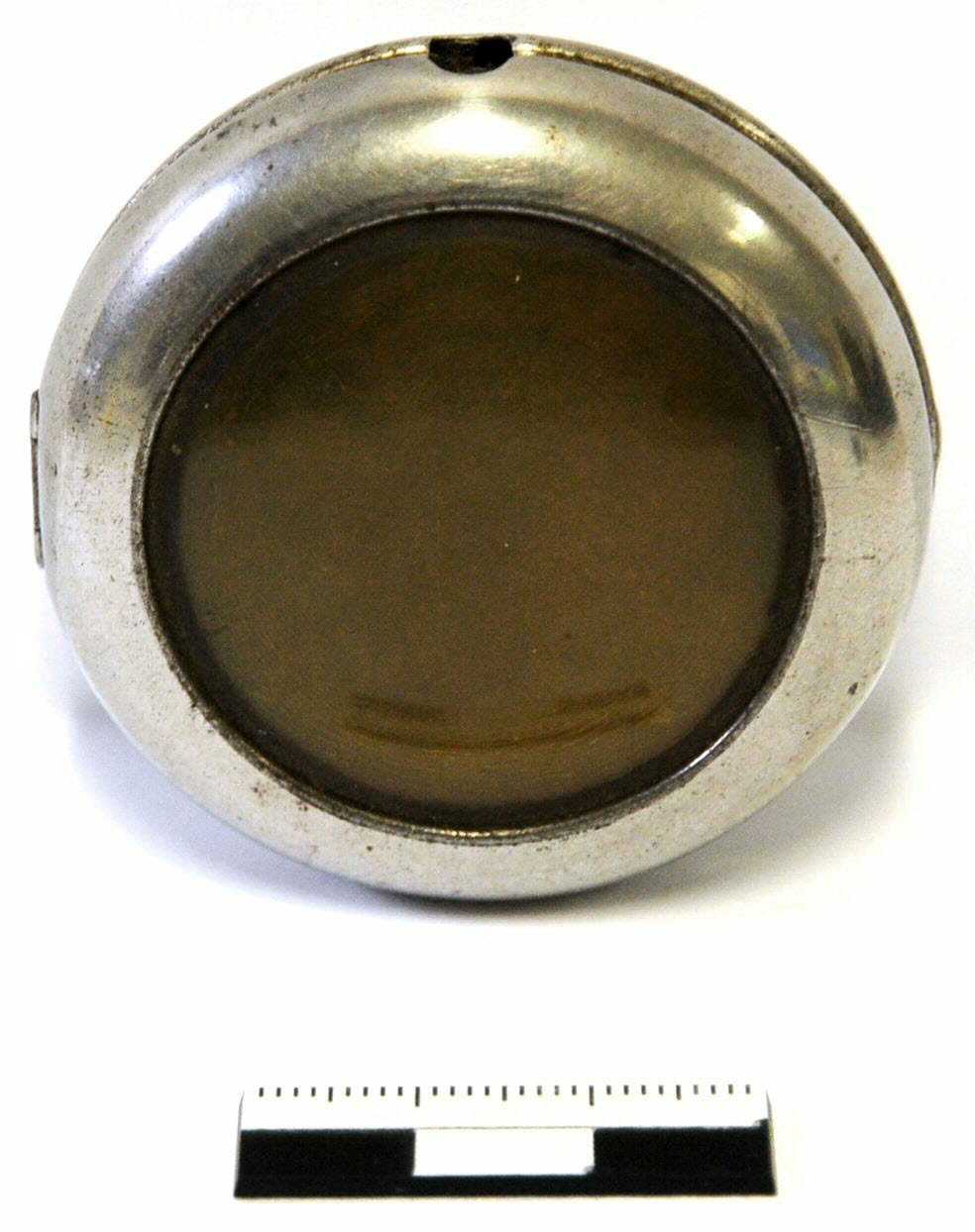
Pocket Watches · Pocket watch
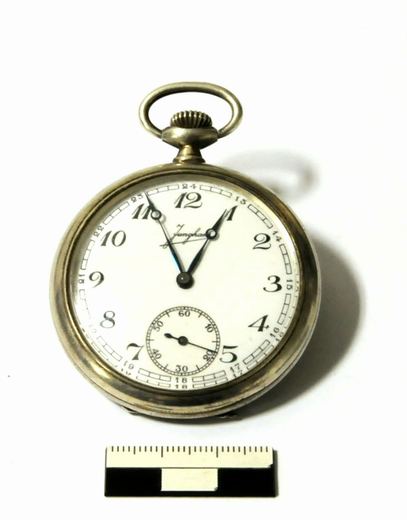
Pocket watch, Germany, 1900–1999 (Montanhistorisches Dokumentationszentrum item_MTROBOYSJILELFVMJY6PCV4NFOSLP2TH)
- Maker / attribution
- Unrecorded in source
- Date
- 1900–1999
- Historical period
- Modern Mechanical Horology (1945 – 1969)
- Country of origin
- Germany
- Place
- Germany
- Object type
- Pocket watch
- Holding institution
- Montanhistorisches Dokumentationszentrum
- Accession / object no.
- item_MTROBOYSJILELFVMJY6PCV4NFOSLP2TH
- Catalogue title (original)
- Schutzgehäuse für Taschenuhr (sog. Uhr- bzw. Bergmannskapsel) (German)
Record summary
Held and catalogued by Montanhistorisches Dokumentationszentrum (object number item_MTROBOYSJILELFVMJY6PCV4NFOSLP2TH), this is a pocket watch, made in Germany, dated 1900–1999. The Atlas places it in the Modern Mechanical Horology period (1945 – 1969) of its Pocket Watches collection. The record is illustrated with 1 photograph.
Assembled from the source record's structured fields. Dates and attributions are given as the source states them; where a field is missing the Atlas leaves it blank rather than estimating.
Catalogue description
Catalogue description from Montanhistorisches Dokumentationszentrum (def)
Rundes Schutzgehäuse aus silberfarbenem Metall mit einem Sichtfenster aus Kunststoff auf der Vorderseite. Beide Hälften sind durch ein Scharnier am linken Rand miteinander verbunden. Am rechten Rand befindet sich eine Nase zur Öffnung des Gehäuses. Zusätzlich weisen beide Hälften am oberen Rand eine Aussparung auf. Die Rückseite ist gestempelt. Im Inneren befindet sich ein rundes Stück Textil. Die Uhrkapsel, eine sog. Bergmannskapsel, ist ein Schutzgehäuse zur Aufnahme einer Taschenuhr zum Schutz u.a. vor Staub, Verschmutzung, Beschädigung und Feuchtigkeit. Bergleute trugen oftmals ihre Taschenuhren auch bei der Arbeit, die besonderen Bedingungen unter Tage machten diesen Schutz der Taschenuhr erforderlich. Es gibt zwei gängige Formen der Uhrkapseln: Bei der runden Ausführung umschließt die Kapsel nicht die gesamte Uhr, der Pendant mit Bügel und Krone liegt durch die Aussparung im Randbereich frei. Dadurch kann die Uhr aufgezogen und die Zeiger gestellt werden, ohne sie aus dem Gehäuse zu entnehmen. Bei der länglichen (birnenförmigen) Ausführung umschließt die Kapsel die gesamte Uhr, zum Einstellen der Uhrzeit und Aufziehen der Uhr ist eine Entnahme der Uhr notwendig. Das Ablesen der Uhrzeit ist jedoch bei beiden Ausführungen im geschlossenen Zustand durch das Sichtfenster möglich. Der Stempel "D.R.G.M." auf der Rückseite der Uhrkapsel steht für Deutsches Reichs-Gebrauchsmuster, mit dem zahlreiche Produkte von 1891 bis 1945 gekennzeichnet wurden. Die Wortmarke "Wartburg" wurde von dem Uhrenhersteller Gebrüder Thiel GmbH verwendet, der auch Schutzgehäuse für Taschenuhren herstellte.
Historical context
Modern Mechanical Horology (1945 – 1969)
Tool watches for divers, pilots and astronauts; electric watches anticipate the electronic age.
After 1945 the pocket watch became a niche product — presentation and railway watches, inexpensive pin-lever watches, and commemorative pieces — while most innovation moved to the wrist.
Read the period in the timelineMore pocket watches from this periodEarlier: Golden Age of Mechanical Watchmaking
Atlas type guide
Pocket watches
The pocket watch was the dominant personal timekeeper from the late seventeenth century until the First World War. Its development tracks the history of the escapement: verge watches with fusees until the late eighteenth century; Thomas Mudge's lever escapement (c. 1755) and the cylinder escapement popularised by George Graham and later by Swiss makers; and the Swiss and English lever watches of the nineteenth century. Lépine's bar-bridge calibre and keyless winding made watches thinner and easier to use.
Industrialisation transformed the trade: American factories such as Waltham (from 1850) and Elgin produced interchangeable parts by machine, and Swiss makers responded with their own mechanisation after the 1876 Philadelphia Exhibition. By 1900 a reliable watch was affordable to millions; the finest makers continued to produce complications and precision watches.
What to look for
- The escapement: verge (crown wheel), cylinder, duplex, English or Swiss lever.
- Key winding (a square arbor in dial or back) or keyless crown winding.
- Signatures and serial numbers on the movement, dial and inside case back.
- Hallmarks, case maker's marks and gold or silver standards stamped in the case.
- Dial material: enamel, silver, gold, later printed metal.
Dating clues
- Verge watches dominate before c. 1800; cylinder watches c. 1770–1900; lever watches after c. 1820.
- Keyless winding: increasingly common after c. 1860.
- Manufacturer serial number lists exist for Waltham, Elgin, Longines, Omega, Patek Philippe and others.
General guidance written by the Atlas editors about this kind of object. It is not a statement about this particular piece; for that, rely on the source record above and on physical examination.
Read next:Verge escapementDetached lever escapementFuseeIdentification Centre
Related records
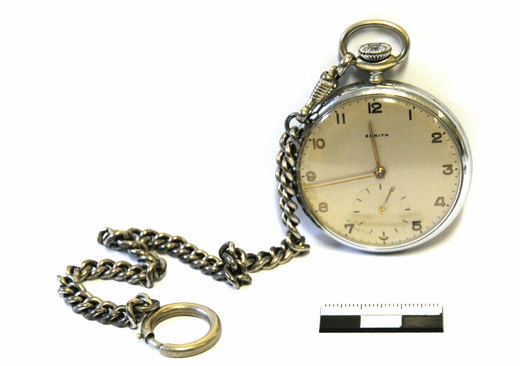
Pocket Watches · 1900–1999
Pocket watch, Germany, 1900–1999 (Montanhistorisches Dokumentationszentrum item_3G6X3MSL3WPKDPOLMSJWMJOIYJJRIQSY)
Montanhistorisches Dokumentationszentrum
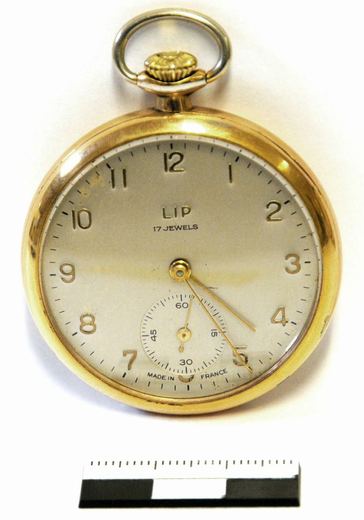
Pocket Watches · 1900–1999
Pocket watch, Germany, 1900–1999 (Montanhistorisches Dokumentationszentrum item_4PFTN3MFMONLAODLRSMZDGCWG7F2VAR4)
Montanhistorisches Dokumentationszentrum
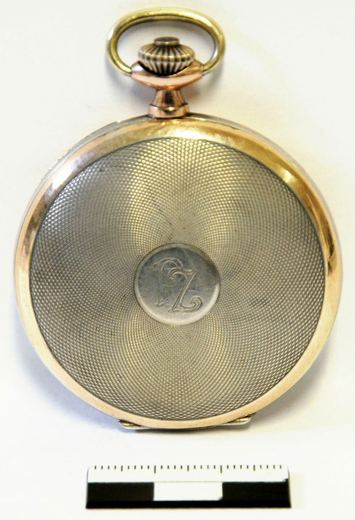
Pocket Watches · 1900–1999
Pocket watch, Germany, 1900–1999 (Montanhistorisches Dokumentationszentrum item_73EVJ2KCROPGEWVDERDT5VGTK2Z7ZFWV)
Montanhistorisches Dokumentationszentrum
Pocket Watches · 1900–1999
Pocket watch, Germany, 1900–1999 (Montanhistorisches Dokumentationszentrum item_B6I74MUJB732B3REKILVNNEMFOCGEQZD)
Montanhistorisches Dokumentationszentrum
Pocket Watches · 1900–1999
Pocket watch, Germany, 1900–1999 (Montanhistorisches Dokumentationszentrum item_DCOIVTJ2V7WUW67HR6MNQIZU2PXZACP2)
Montanhistorisches Dokumentationszentrum
Pocket Watches · 1900–1999
Pocket watch, Germany, 1900–1999 (Montanhistorisches Dokumentationszentrum item_GJYA4K2SCXWFR6AWUKUDILLH2AKWETZ4)
Montanhistorisches Dokumentationszentrum
Pocket Watches · 1900–1999
Pocket watch, Germany, 1900–1999 (Montanhistorisches Dokumentationszentrum item_GSFJ4ZSH5KHIEZA2QN2WPRBUW7Z33NAL)
Montanhistorisches Dokumentationszentrum
Pocket Watches · 1900–1999
Pocket watch, Germany, 1900–1999 (Montanhistorisches Dokumentationszentrum item_QJHHI55PP6ZQHN6QG3V4T5IMWGG2C47N)
Montanhistorisches Dokumentationszentrum