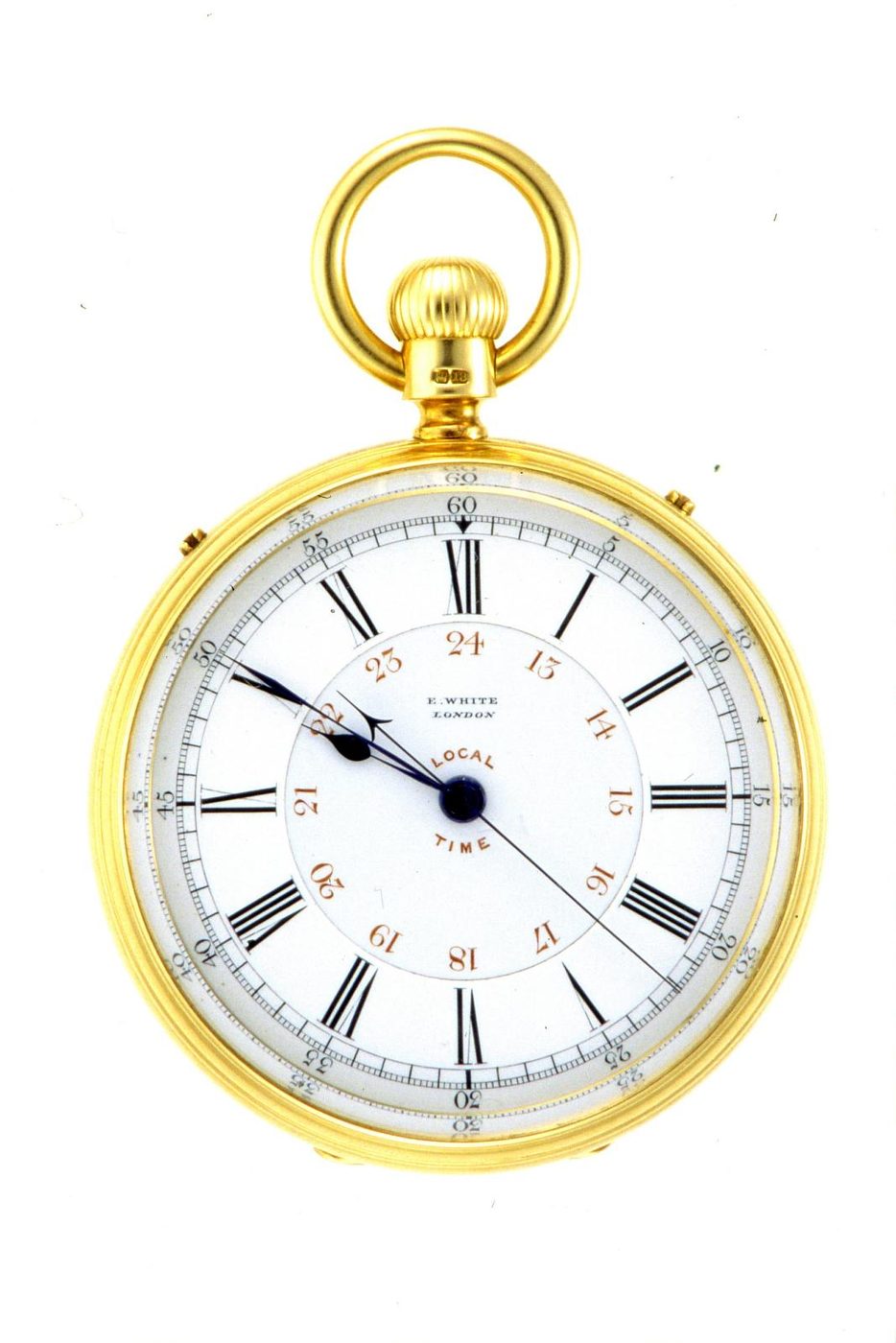
Pocket Watches · Pocket watch
Pocket watch by Nicole, Nielsen & Co., United Kingdom, ca 1880
- Maker / attribution
- Nicole, Nielsen & Co. (maker)
- Date
- ca 1880
- Historical period
- Industrial Revolution (1850 – 1900)
- Country of origin
- United Kingdom
- Place
- United Kingdom: England
- Object type
- Pocket watch
- Dimensions
- brass, gilded (movement material); gold (case material); overall: 2 3/4 in x 2 in x 5/8 in; 6.985 cm x 5.08 cm x 1.5875 cm
- Holding institution
- National Museum of American History, Smithsonian Institution, Washington DC
- Accession / object no.
- 1990.0659.01
- Catalogue title (original)
- Sir Sandford Fleming's Pocketwatch
Record summary
Held and catalogued by National Museum of American History, Smithsonian Institution, Washington DC (object number 1990.0659.01), this is a pocket watch by Nicole, Nielsen & Co., made in United Kingdom: England, dated ca 1880. The Atlas places it in the Industrial Revolution period (1850 – 1900) of its Pocket Watches collection. Recorded dimensions: brass, gilded (movement material); gold (case material); overall: 2 3/4 in x 2 in x 5/8 in; 6.985 cm x 5.08 cm x 1.5875 cm. The record is illustrated with 4 photographs.
Assembled from the source record's structured fields. Dates and attributions are given as the source states them; where a field is missing the Atlas leaves it blank rather than estimating.
Catalogue description
Description
This watch belonged to Sir Sandford Fleming, chief engineer of the Canadian Pacific Railway. About 1880, Fleming devised a plan for worldwide time zones and had a complicated watch made to reflect both zoned time and local time.
Description
The maker of Fleming's watch is the London firm of Nicole, Nielsen & Co. Successor to a business founded by Swiss immigrants Adolphe Nicole and Jules Capt in the late 1830s, the firm made high-quality timepieces. Fleming ordered the watch through retailer E. White, also of London.
Description
Fleming's first notions about time reform emerged on a trip to Ireland in 1876, when he missed a train because he misread a timetable. His initial plan concentrated on replacing the two twelve-hour designations of the day, A.M. and P.M., with a twenty-four hour system. Almost immediately, though, he expanded his ideas about time reform to propose a system he called variously "Terrestrial Time," "Cosmopolitan Time," and "Cosmic Time"-a division of the globe into twenty-four zones, each one hour apart and identified by letters of the alphabet.
Description
As the 1880s began there was no binding international agreement about how to keep time for the world. Traditionally, each country used its own capital city or main observatory for measuring time and designating lines of longitude on national maps. After publication of the British Nautical Almanac began in 1767, many nations came to use Greenwich time for navigation and some scientific observations. Local mean time served for all other activities.
Description
Added emphasis on Greenwich had come from North America when the railroads there voluntarily adopted a standard zoned time in 1883. In that system, the zones were based on meridians counted west from Greenwich, England, at zero degree of longitude.
Description
Fleming was not the first or only proponent of world standard time. Quirico Filopanti, an Italian mathematics and engineering professor, for example, published a scheme based on twenty-four zones counted from Rome as prime meridian in 1858.
Description
Organized international support emerged slowly for fixing a common prime meridian. Not until October 1884 did diplomats and technical specialists gather to act on scientific proposals. The International Meridian Conference, held in Washington, DC, recommended that the nations of the world establish a prime meridian at Greenwich, count longitude east and west from the prime meridian up to 180 degrees in each direction, and adopt a universal day beginning at Greenwich at midnight. Although the International Meridian Conference had no authority to enforce its suggestions, the meeting resulted in the gradual worldwide adoption of a time-zone based system with Greenwich as zero degrees.
Description
The military and some civilian science, aviation and navigation efforts still use alphabet identifiers for time zones. The time of day in Zone Z is known as "Zulu Time." The zone is governed by the zero degree of longitude that runs through Greenwich.
Historical context
Industrial Revolution (1850 – 1900)
American interchangeable-parts manufacture; railroad time standards; Swiss and German factory systems.
Machine production with interchangeable parts, pioneered by Waltham (1850s) and adopted by Elgin, Longines, Omega and others, made reliable lever watches widely affordable. Keyless winding became standard, railroad watch standards were introduced (1890s), and Swiss and American industries competed globally.
Read the period in the timelineMore pocket watches from this periodEarlier: Precision & Scientific Horology
Atlas type guide
Pocket watches
The pocket watch was the dominant personal timekeeper from the late seventeenth century until the First World War. Its development tracks the history of the escapement: verge watches with fusees until the late eighteenth century; Thomas Mudge's lever escapement (c. 1755) and the cylinder escapement popularised by George Graham and later by Swiss makers; and the Swiss and English lever watches of the nineteenth century. Lépine's bar-bridge calibre and keyless winding made watches thinner and easier to use.
Industrialisation transformed the trade: American factories such as Waltham (from 1850) and Elgin produced interchangeable parts by machine, and Swiss makers responded with their own mechanisation after the 1876 Philadelphia Exhibition. By 1900 a reliable watch was affordable to millions; the finest makers continued to produce complications and precision watches.
What to look for
- The escapement: verge (crown wheel), cylinder, duplex, English or Swiss lever.
- Key winding (a square arbor in dial or back) or keyless crown winding.
- Signatures and serial numbers on the movement, dial and inside case back.
- Hallmarks, case maker's marks and gold or silver standards stamped in the case.
- Dial material: enamel, silver, gold, later printed metal.
Dating clues
- Verge watches dominate before c. 1800; cylinder watches c. 1770–1900; lever watches after c. 1820.
- Keyless winding: increasingly common after c. 1860.
- Manufacturer serial number lists exist for Waltham, Elgin, Longines, Omega, Patek Philippe and others.
General guidance written by the Atlas editors about this kind of object. It is not a statement about this particular piece; for that, rely on the source record above and on physical examination.
Read next:Verge escapementDetached lever escapementFuseeIdentification Centre
Related records
Pocket Watches · 19th or 20th century, in the style of 16th–early 17th century
Watch by Thomas Tompion, United Kingdom, 1800–1917
The Metropolitan Museum of Art, New York
Pocket Watches · 1835-1875
Pocket watch by Holliday, Cornelius Brooks, United Kingdom, 1835-1875
Science Museum Group, London
Pocket Watches · 1862
Pocket watch by Cha.s Frodsham, United Kingdom, 1862
German Clock Museum
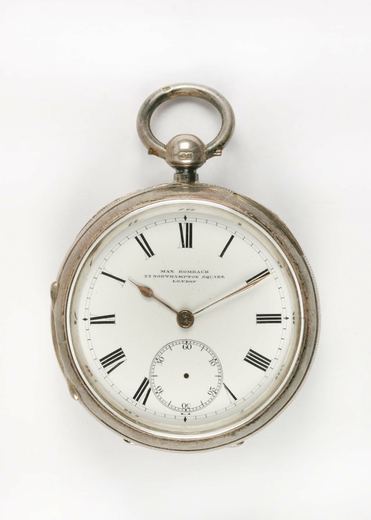
Pocket Watches · 1893
Pocket watch by Max Rombach, United Kingdom, 1893
German Clock Museum
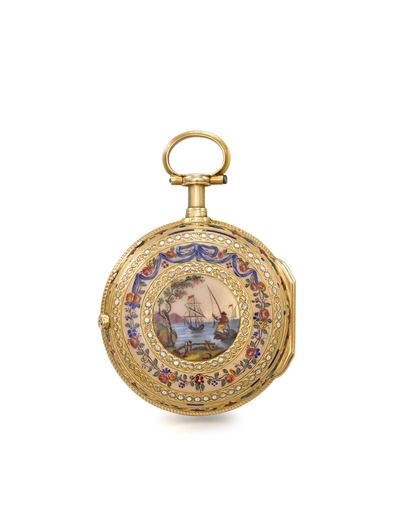
Pocket Watches · 1801-1900
Pocket watch by L'Epine, Jean Antoine, France, 1801-1900
Science Museum Group, London
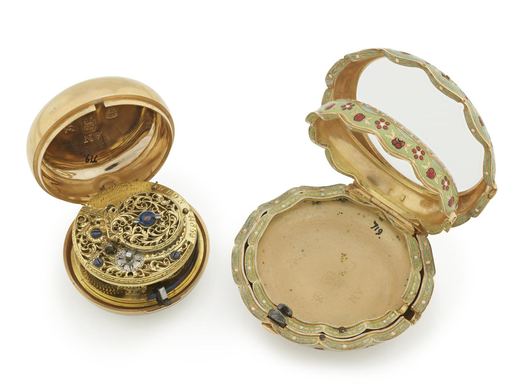
Pocket Watches · 1801-1900
Pocket watch by Markwick, Markham; Perigal family, England, 1801-1900
Science Museum Group, London
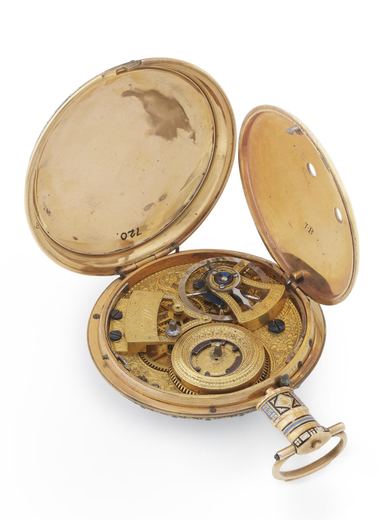
Pocket Watches · 1801-1900
Pocket watch by William Ilbery, England, 1801-1900
Science Museum Group, London
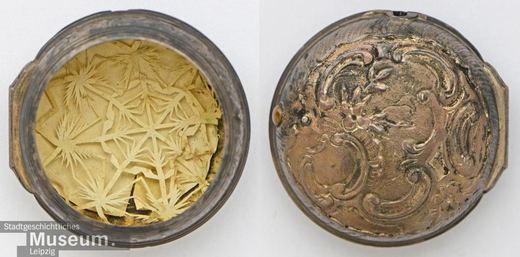
Pocket Watches · 1801–1900
Pocket watch, 1801–1900
Museum of City History Leipzig