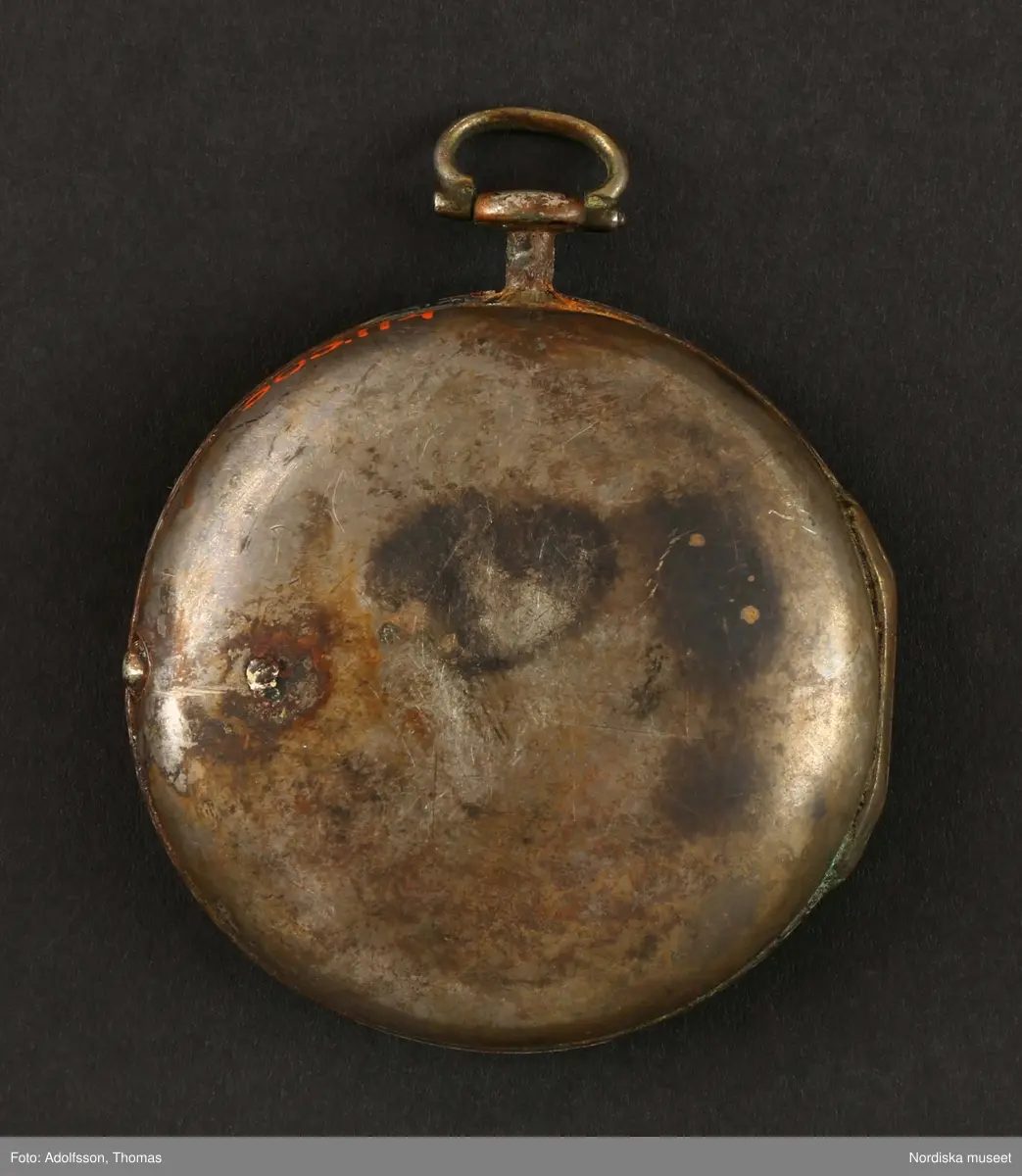
Pocket Watches · Pocket watch
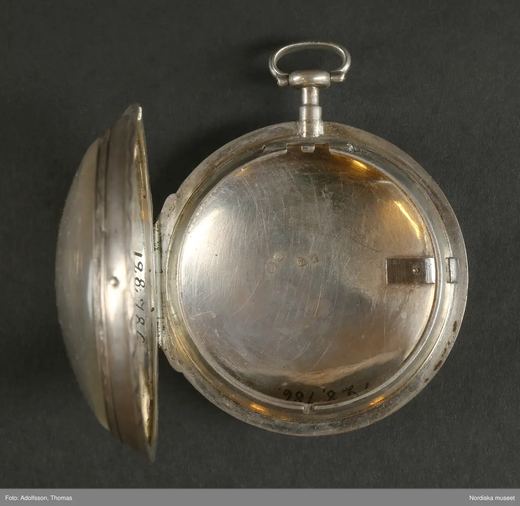
Pocket watch by Eric Sundberg, Sweden, 1700–1799
- Maker / attribution
- Eric Sundberg (creator)
- Date
- 1700–1799
- Historical period
- Early Modern Horology (1600 – 1750)
- Country of origin
- Sweden
- Place
- Sweden
- Object type
- Pocket watch
- Holding institution
- Nordic Museum Foundation
- Accession / object no.
- nomu_object_NM0303114
- Catalogue title (original)
- Fickur
Record summary
Held and catalogued by Nordic Museum Foundation (object number nomu_object_NM0303114), this is a pocket watch by Eric Sundberg, made in Sweden, dated 1700–1799. The Atlas places it in the Early Modern Horology period (1600 – 1750) of its Pocket Watches collection. The record is illustrated with 1 photograph.
Assembled from the source record's structured fields. Dates and attributions are given as the source states them; where a field is missing the Atlas leaves it blank rather than estimating.
Catalogue description
Catalogue description from Nordic Museum Foundation (Swedish)
Fickuret har tillhört Evald Götrik Kallstenius (1868-1892 enl HL) som deltog i Björling-Kallsteniusexpeditionen till nordvästra Grönland 1892. Expeditionen seglade på skeppet Ripple och hade förutom Björling och Kallstenius tre besättningsmän. Efter att inte hört av expeditionen gjordes efterforskningar 1894 och man fann efterlämnade föremål på Cary-ön utanför Grönland, bland annat detta fickur. Troligen hade man där lämnat föremål som ej var nödvändiga, då man gav sig iväg i mindre båtar, då expeditionsbåten förstörts. Klockan hade tidigare tillhört Kallstenius farfar Göran Samuel Kallstenius (1786-1863) Tillhörande nyckel nummer NM.0303115. Expeditionsledaren Johan Alfred Björlings kappa finns också i Nordiska museets samlingar (nummer NM.0181214).' /Leif Wallin 2016-09-22
Shown in the original language of the source catalogue. An editor-reviewed English translation has not yet been published; we do not publish machine translations as authoritative text.
Historical context
Early Modern Horology (1600 – 1750)
Huygens' pendulum and balance spring transform accuracy; English makers develop the anchor and deadbeat escapements.
The balance spring (c. 1675) improved watches dramatically and introduced the minute hand. English pair-cased verge watches with pierced balance cocks and French oignons were typical; enamel painting at Blois and Geneva, and the repeating watch (1680s), made watches objects of great refinement.
Read the period in the timelineMore pocket watches from this periodEarlier: Renaissance Horology
Atlas type guide
Pocket watches
The pocket watch was the dominant personal timekeeper from the late seventeenth century until the First World War. Its development tracks the history of the escapement: verge watches with fusees until the late eighteenth century; Thomas Mudge's lever escapement (c. 1755) and the cylinder escapement popularised by George Graham and later by Swiss makers; and the Swiss and English lever watches of the nineteenth century. Lépine's bar-bridge calibre and keyless winding made watches thinner and easier to use.
Industrialisation transformed the trade: American factories such as Waltham (from 1850) and Elgin produced interchangeable parts by machine, and Swiss makers responded with their own mechanisation after the 1876 Philadelphia Exhibition. By 1900 a reliable watch was affordable to millions; the finest makers continued to produce complications and precision watches.
What to look for
- The escapement: verge (crown wheel), cylinder, duplex, English or Swiss lever.
- Key winding (a square arbor in dial or back) or keyless crown winding.
- Signatures and serial numbers on the movement, dial and inside case back.
- Hallmarks, case maker's marks and gold or silver standards stamped in the case.
- Dial material: enamel, silver, gold, later printed metal.
Dating clues
- Verge watches dominate before c. 1800; cylinder watches c. 1770–1900; lever watches after c. 1820.
- Keyless winding: increasingly common after c. 1860.
- Manufacturer serial number lists exist for Waltham, Elgin, Longines, Omega, Patek Philippe and others.
General guidance written by the Atlas editors about this kind of object. It is not a statement about this particular piece; for that, rely on the source record above and on physical examination.
Read next:Verge escapementDetached lever escapementFuseeIdentification Centre
Related records
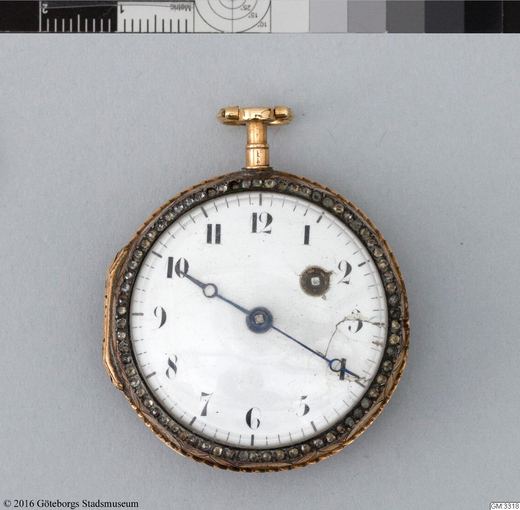
Pocket Watches · 1700–1799
Pocket watch by Jana Mäkinen, Sweden, 1700–1799
Museum of Gothenburg
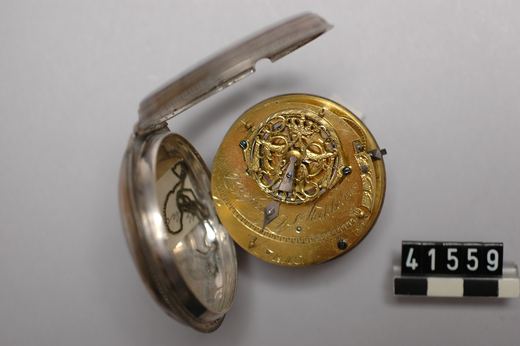
Pocket Watches · 1700–1799
Pocket watch by Joacim (den äldste) Hovenschiöld, Sweden, 1700–1799
Swedish National Museum of Science and Technology
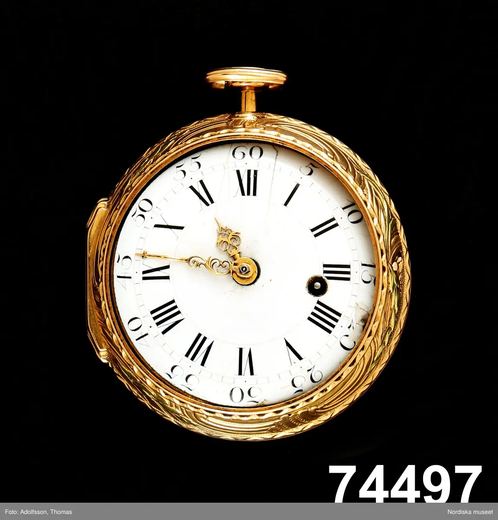
Pocket Watches · 1700–1799
Pocket watch by Joakim Hovenschiöld, Sweden, 1700–1799
Nordic Museum Foundation
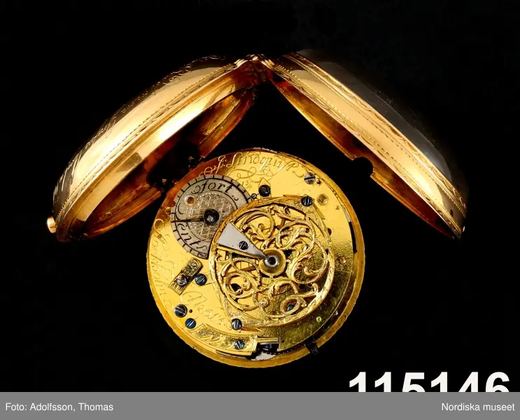
Pocket Watches · 1700–1799
Pocket watch by Johan Lindquist, Sweden, 1700–1799 (Nordic Museum Foundation nomu_object_NM0115146)
Nordic Museum Foundation
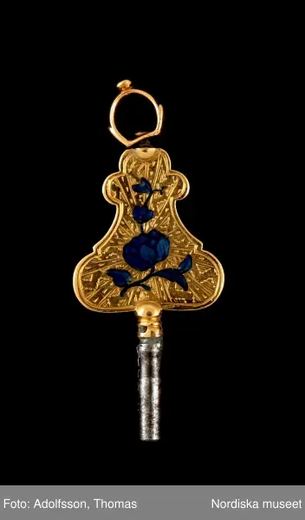
Pocket Watches · 1700–1799
Pocket watch by Johan Lindquist, Sweden, 1700–1799 (Nordic Museum Foundation nomu_object_NM0253370_2B_2A1)
Nordic Museum Foundation
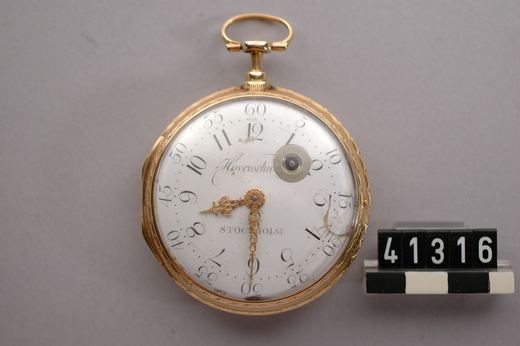
Pocket Watches · 1700–1799
Pocket watch by Olof Ekman, Sweden, 1700–1799
Swedish National Museum of Science and Technology
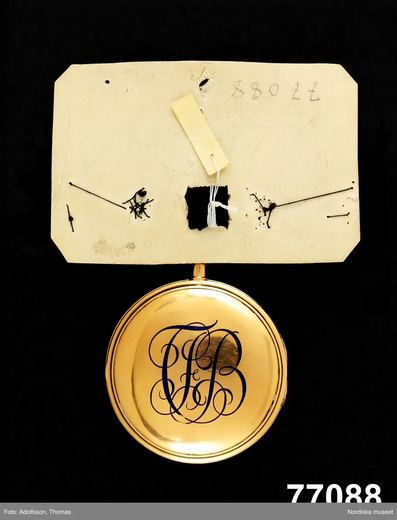
Pocket Watches · 1700–1799
Pocket watch by P H Beurling, Sweden, 1700–1799
Nordic Museum Foundation
Pocket Watches · 1700–1799
Pocket watch by Pehr Printz, Sweden, 1700–1799
Nordic Museum Foundation