Instruments · Nocturnal
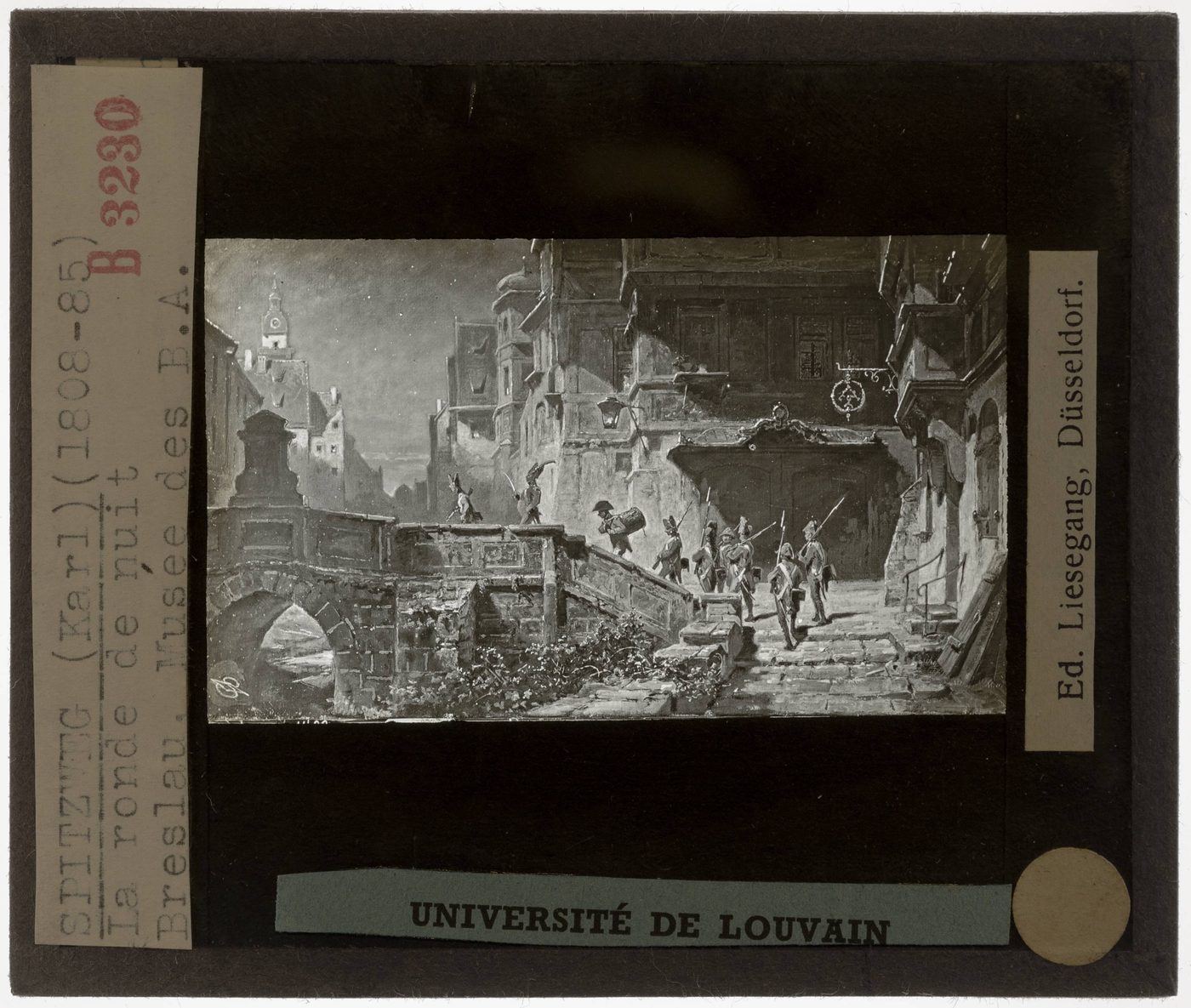
Nocturnal by Carl Spitzweg, Germany, 1875
- Maker / attribution
- Carl Spitzweg (creator)
- Date
- 1875
- Historical period
- Industrial Revolution (1850 – 1900)
- Country of origin
- Germany
- Object type
- Nocturnal
- Holding institution
- Catholic University of Leuven
- Accession / object no.
- photography_ProvidedCHO_KU_Leuven_9988284140101488
- Catalogue title (original)
- Carl Spitzweg. Nocturnal round (English)
Record summary
Held and catalogued by Catholic University of Leuven (object number photography_ProvidedCHO_KU_Leuven_9988284140101488), this is a nocturnal by Carl Spitzweg, made in Germany, dated 1875. The Atlas places it in the Industrial Revolution period (1850 – 1900) of its Instruments collection. The record is illustrated with 1 photograph.
Assembled from the source record's structured fields. Dates and attributions are given as the source states them; where a field is missing the Atlas leaves it blank rather than estimating.
Catalogue description
Catalogue description from Catholic University of Leuven (English)
KU Leuven. Glass slides art history. Université de Louvain, between 1839 and 1939. Photographer unknown. Added information on slide. Style: Romantic. Creation/Building: c. 1875. Technique/Material: Oil on canvas. Current location: Munich, Neue Pinakothek (?). EuroPhot. Art History. 19th century. Painting. Topographical view. Townscape and villagescape.
Historical context
Industrial Revolution (1850 – 1900)
American interchangeable-parts manufacture; railroad time standards; Swiss and German factory systems.
Instruments spread into industry, science and sport: stopwatches, chronoscopes, metronomes, watchmen's clocks and time recorders.
Read the period in the timelineMore instruments from this periodEarlier: Precision & Scientific Horology
Atlas type guide
Nocturnals
A nocturnal tells the time at night from the rotation of the stars around the celestial pole. The user sights Polaris through the central hole and turns a long pointer to align with the 'guard' stars of the Little Bear or the 'pointers' of the Great Bear. A calendar scale set to the date converts that angle to the hour.
Nocturnals were used from the sixteenth to the eighteenth century by navigators and travellers. Many are made of boxwood or brass, with tactile teeth on the hour disc so that the time can be counted in the dark.
What to look for
- A central sighting hole and a long index arm.
- Engraved letters such as 'B' (Bear) or 'BB' indicating which constellation to use.
- Teeth on the hour disc with a longer tooth for midnight.
Dating clues
- Most surviving nocturnals date from about 1550 to 1750.
General guidance written by the Atlas editors about this kind of object. It is not a statement about this particular piece; for that, rely on the source record above and on physical examination.
Related records
Instruments · 1855
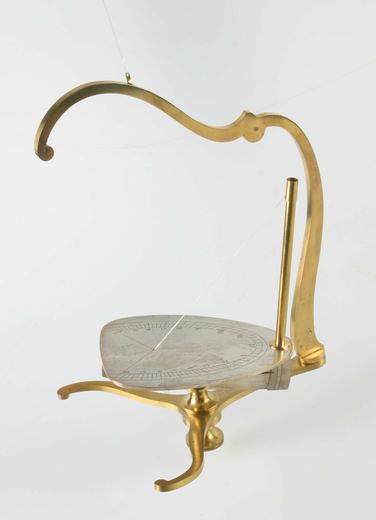
Sundial by E. Boissier, Germany, 1855
German Clock Museum
Instruments · 1862
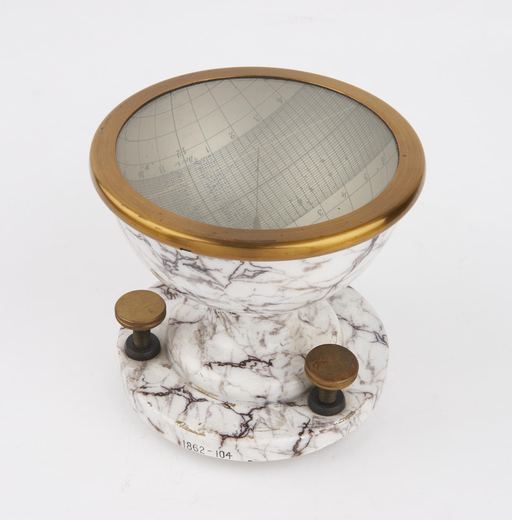
Hemispherical sundial, on porcelain stand with glass cover, inscribed "H Schmeisser Patent 1861 Berlin A Meissner".
Science Museum Group, London
Instruments · 1877–1894
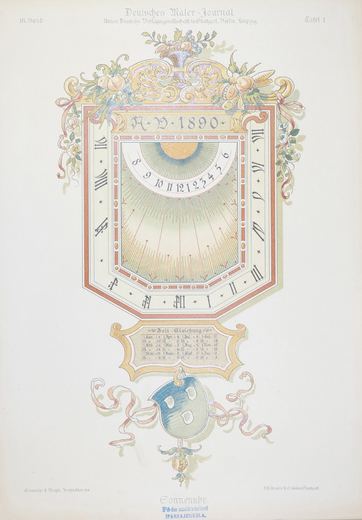
Sundial by Stuttgart Eckstein, Germany, 1877–1894
Schola Graphidis Art Collection, Budapest
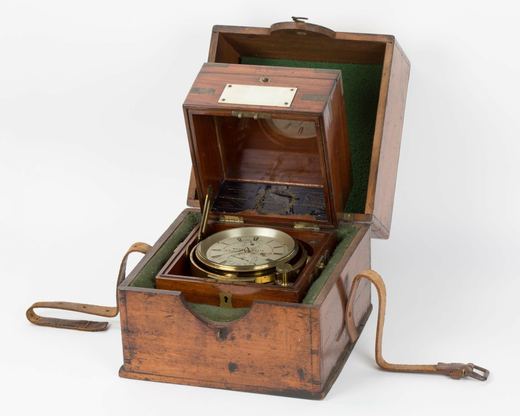
Instruments · 1880
Marine chronometer by Nugent Wells, Germany, 1880
German Clock Museum
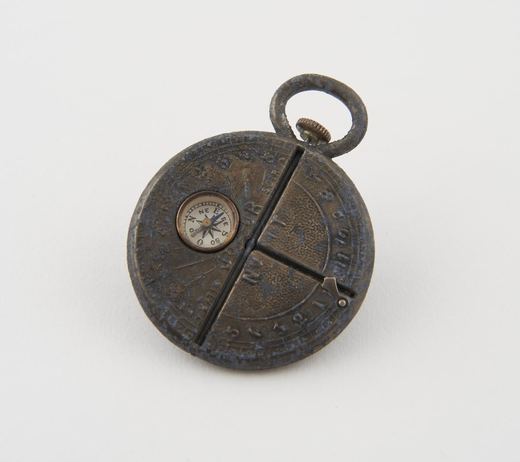
Instruments · 1800-1900
Metal, possibly silver alloy, sundial in shape of pocket watch includes a compass. French, 1800-1900
Science Museum Group, London
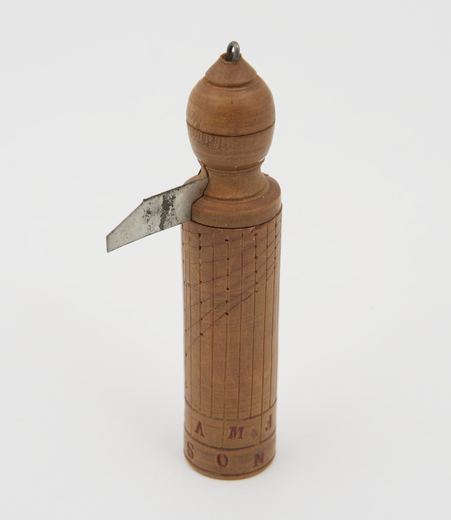
Instruments · 1801-1900
Cylinder sundial or 'Shepherd's dial', for use at latitude 42°. Rough construction. Made in France, 1801-1900 (see note).
Science Museum Group, London
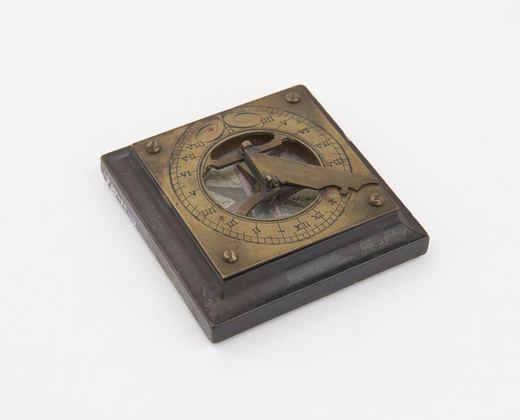
Instruments · 1801-1899
French portable horizontal sundial for latitude 49°, in brass with wooden base ( A33438)
Science Museum Group, London
Instruments · 1801-1900
Marine chronometer by Young, Charles, England, 1801-1900
Science Museum Group, London