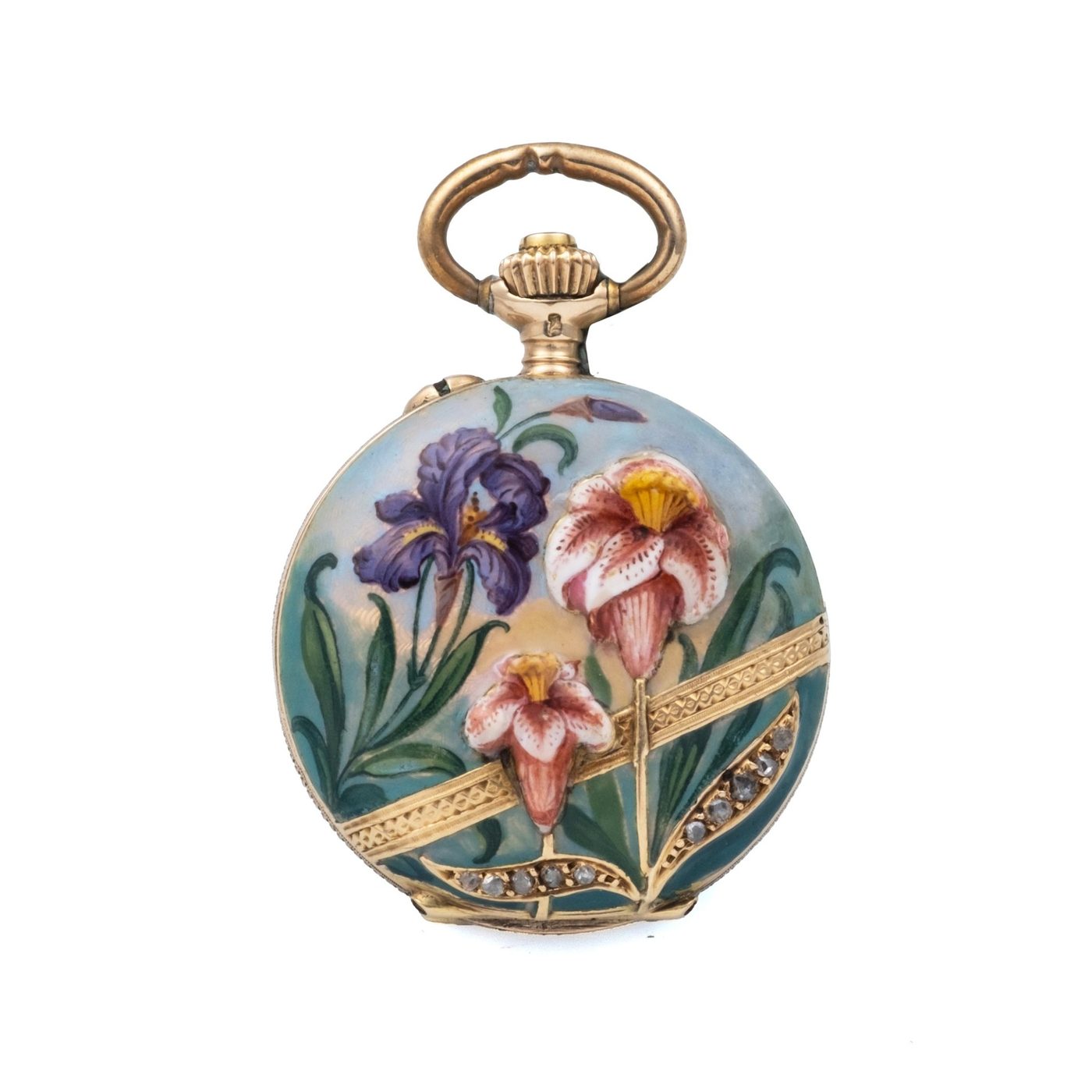
Pocket Watches · Pendant watch
Borel & Cie Ireies and Lilies, circa 1890
- Maker / attribution
- Borel & Cie (brand / maker)
- Date
- circa 1890
- Historical period
- Industrial Revolution (1850 – 1900)
- Country of origin
- Switzerland
- Object type
- Pendant watch
- Dimensions
- 25 mm ; weight 17 gr.
- Auction house
- Antiquorum auction archive, Geneva
- Lot
- Lot 389-15
- Credit line
- Auction lot record: LOT 15
- Catalogue title (original)
- BOREL & CIE, SWITZERLAND, IREIES AND LILIES, SMALL PENDANT WATCH HIGH RELIEF ENAMEL, GOLD
Record summary
Catalogued by Antiquorum auction archive, Geneva (lot Lot 389-15), this is a pendant watch by Borel & Cie, made in Switzerland, dated circa 1890. The Atlas places it in the Industrial Revolution period (1850 – 1900) of its Pocket Watches collection. Recorded dimensions: 25 mm ; weight 17 gr. The record is illustrated with 3 photographs.
Assembled from the source record's structured fields. Dates and attributions are given as the source states them; where a field is missing the Atlas leaves it blank rather than estimating.
Catalogue description
Antiquorum catalogue description
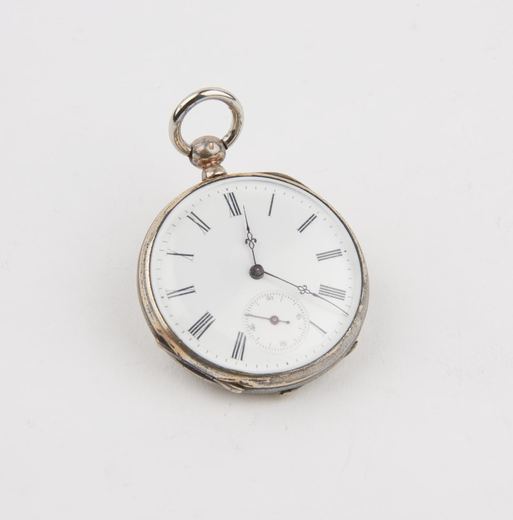
EUR 1,100 - 2,200 / CHF 1,000 - 2,000 / USD 1,250 - 2,500 / JPY 190,000 - 378,000 A fine and elegant, 14k yellow gold and enamel, manual wind Hunting-case, keyless-winding pendant watch. Polychrome high-relief enamel decoration depicting irises and lilies, flowers traditionally symbolizing wisdom and faith. White enamel dial with Roman numerals, gold Louis xvi hands.
Lot specifications (Antiquorum)
Caliber: 20 mm., 10 jewels, cylinder escapement; Case No.: 30818; Signature: Dial
Historical context
Industrial Revolution (1850 – 1900)
American interchangeable-parts manufacture; railroad time standards; Swiss and German factory systems.
Machine production with interchangeable parts, pioneered by Waltham (1850s) and adopted by Elgin, Longines, Omega and others, made reliable lever watches widely affordable. Keyless winding became standard, railroad watch standards were introduced (1890s), and Swiss and American industries competed globally.
Read the period in the timelineMore pocket watches from this periodEarlier: Precision & Scientific Horology
Atlas type guide
Early spring-driven watches
Portable spring-driven timepieces appeared in southern Germany, France and Italy in the early sixteenth century; Peter Henlein of Nuremberg is traditionally credited, although the historical record is complex. These early watches were worn as pendants or carried, had iron or brass movements with a verge escapement and a foliot or small balance, and used a stackfreed or fusee to equalise spring force. They indicated hours only and were notoriously inaccurate.
From the later sixteenth century watches were made in Blois, Paris, Geneva, London and Augsburg in oval, octagonal, cruciform, skull and other 'form' cases of rock crystal, gilt brass, silver and enamel. They were jewellery and status objects as much as timekeepers.
What to look for
- A single hour hand and often a touch-pin hour ring for feeling the time.
- Stackfreed (a cam and spring) instead of a fusee on German watches.
- Pierced and engraved cocks over the balance, fine gut fusee lines.
- Rock-crystal, enamelled or engraved form cases.
Dating clues
- Drum-shaped German watches: c. 1530–1580.
- Oval and form watches: c. 1580–1650.
- Before c. 1675 there is no balance spring; watches can vary by many minutes a day.
General guidance written by the Atlas editors about this kind of object. It is not a statement about this particular piece; for that, rely on the source record above and on physical examination.
Related records
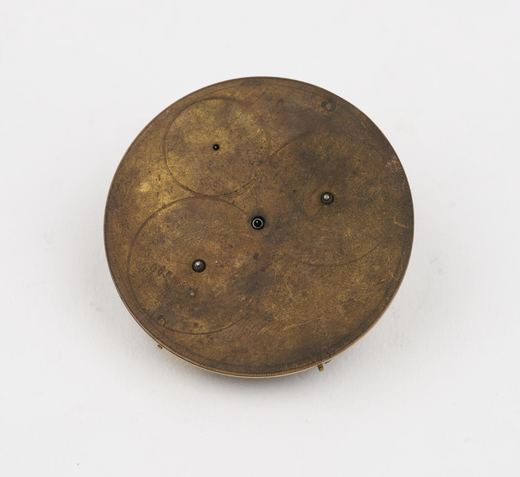
Pocket Watches · 1801-1900
Pocket watch, Switzerland, 1801-1900
Science Museum Group, London
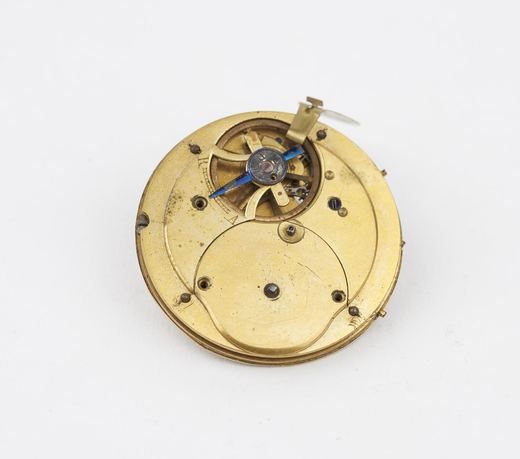
Pocket Watches · 1801-1900
Swiss or French movement with horizontal escapement including "Jumper" mechanism, damaged (cylinder broken), incomplete (dial etc. missing) no.390, 1801-1900
Science Museum Group, London
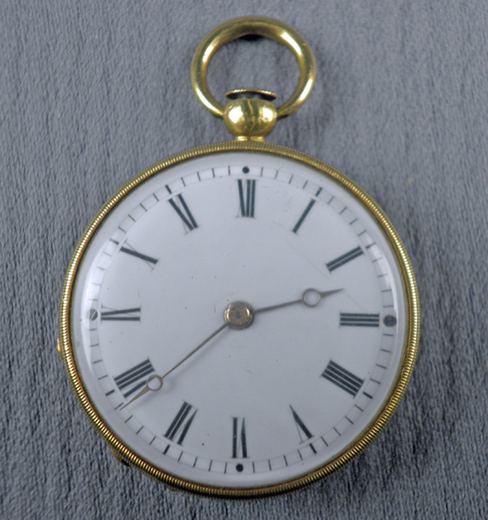
Pocket Watches · 1818–1902
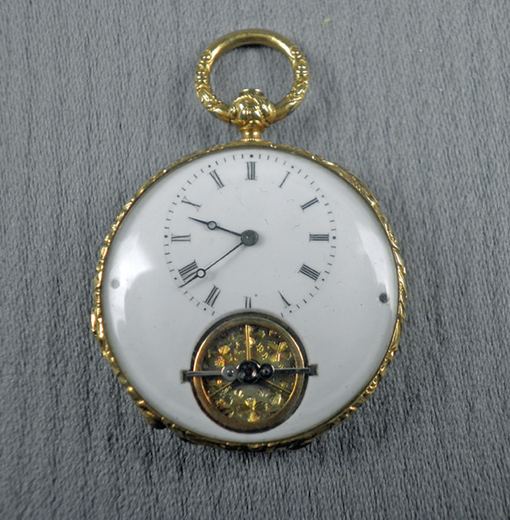
Pocket watch, Switzerland, 1818–1902 (Sörmland Museum SLM_item_305547)
Sörmland Museum
Pocket Watches · 1818–1902
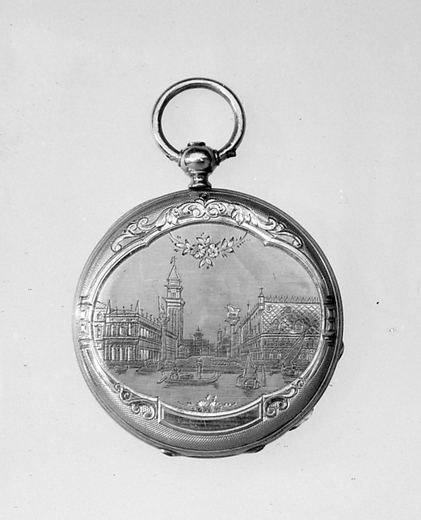
Pocket watch, Switzerland, 1818–1902 (Sörmland Museum SLM_item_305548)
Sörmland Museum
Pocket Watches · ca. 1850
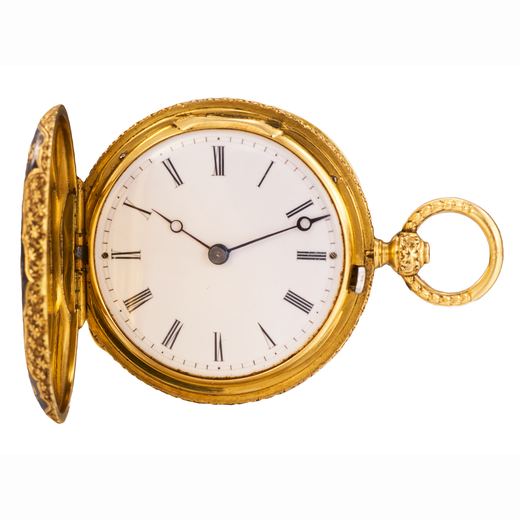
Watch by Eugène Bornand, Switzerland, ca. 1850
The Metropolitan Museum of Art, New York
Pocket Watches · circa 1850-1870
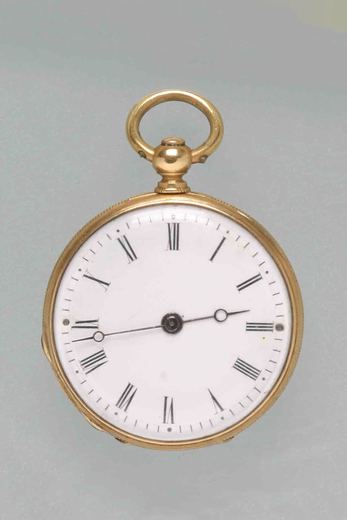
A. Golay Leresche watch, circa 1850-1870
Antiquorum auction archive, Geneva
Pocket Watches · 1850
Pocket watch by D Bachelard et Fils, Switzerland, 1850
German Clock Museum
Pocket Watches · 1850-1899
Pocket watch by GT, Switzerland, 1850-1899
Science Museum Group, London