Watchmaking Industry · Historical investigation
Christmas Day, 1969: The Seiko Astron and the Quartz Revolution
How a gold watch released in Tokyo — with a crystal vibrating 8,192 times a second — reshaped the global watch industry within fifteen years.
Atlas Editorial ·
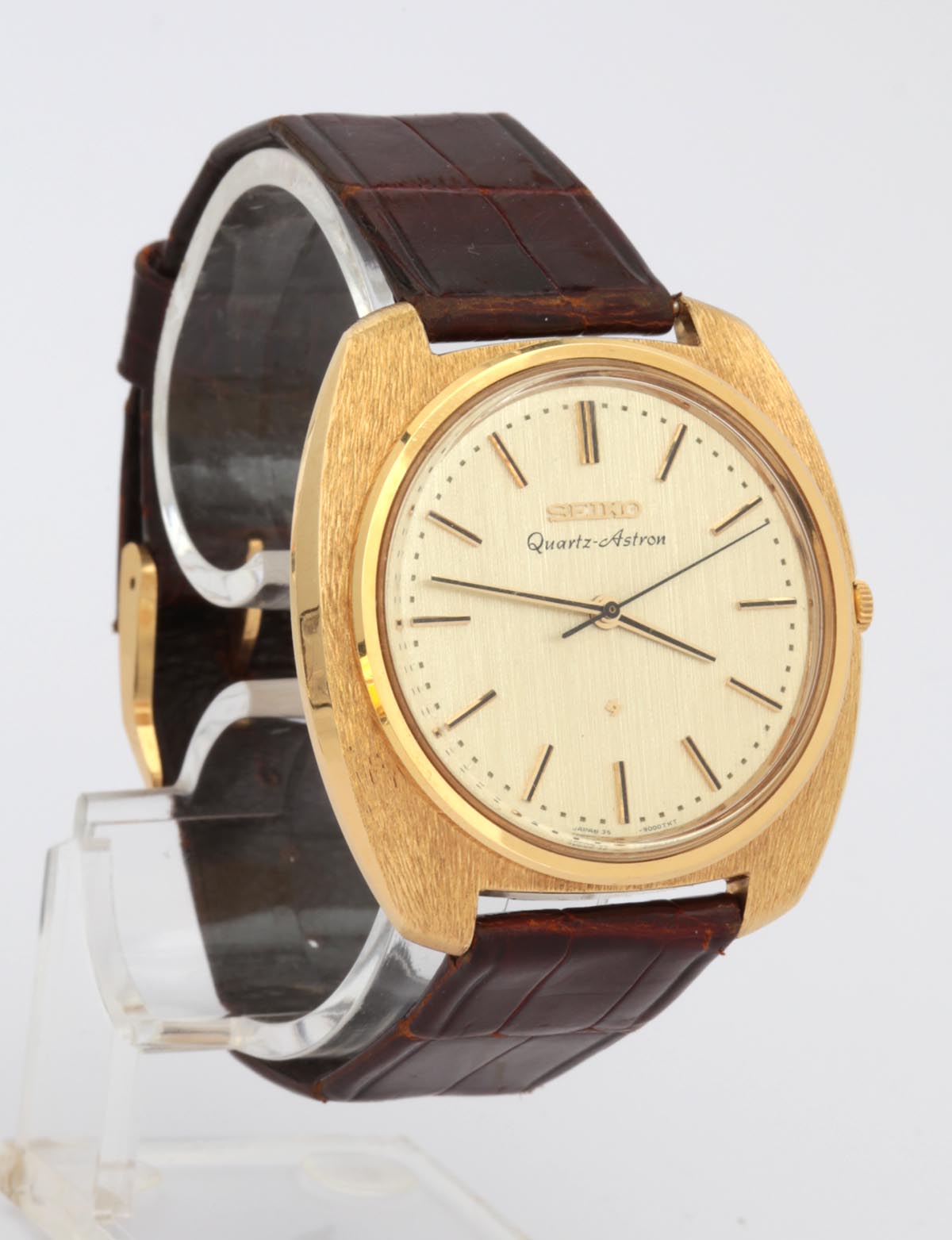
Deutsches-uhrenmuseum · CC BY-SA 4.0 · source
On 25 December 1969 a small number of gold wristwatches went on sale in Tokyo. They looked conventional: a round case, a simple dial, hour and minute hands, a seconds hand that jumped rather than swept. Their price was roughly that of a small car. Inside, there was no balance wheel and no hairspring. Instead, a tiny tuning-fork-shaped quartz crystal, driven by an electronic circuit, vibrated 8,192 times every second. The watch was the Seiko Quartz Astron 35SQ, the first quartz wristwatch sold to the public, and it opened what the watch industry would come to call the quartz revolution — or, in Switzerland, the quartz crisis.
From observatory to wrist
Quartz timekeeping was not new in 1969. Piezoelectric quartz — which flexes when a voltage is applied and generates a voltage when flexed — had been used to control radio frequencies since the 1920s, and Warren Marrison and J. W. Horton at Bell Telephone Laboratories built the first quartz clock in 1927. By the 1930s and 1940s, quartz clocks the size of cabinets were the most accurate timekeepers in observatories and national laboratories, outperforming the finest pendulum regulators. The challenge was miniaturisation: shrinking the crystal, the oscillator circuit, the frequency divider and the motor to fit in a watch, and making them run for a year on a button cell.
Several groups pursued this in the 1960s. In Switzerland, the Centre Electronique Horloger (CEH) in Neuchâtel developed the Beta series of quartz prototypes, which took top places in the Neuchâtel Observatory chronometry competition of 1967. Seiko, which had supplied quartz timing equipment for the 1964 Tokyo Olympics and developed portable quartz chronometers, was working toward the same goal. Seiko reached the market first.
Inside the 35A
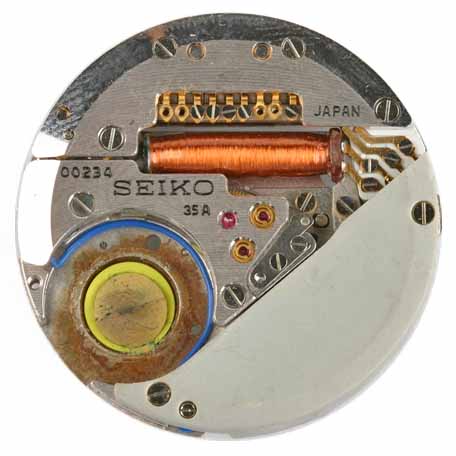
| Field | Value | Status |
|---|---|---|
| Release | 25 December 1969, Tokyo | Documented |
| Movement | Seiko calibre 35A | Documented |
| Crystal frequency | 8,192 Hz | Documented |
| Case | 18k gold | Documented |
| Stated accuracy | About ±5 seconds per month | Documented (manufacturer claim) |
| Production quantity | Small; exact figure varies by source | Under research |
The figure of ±5 seconds per month is striking. A good mechanical chronometer of the time, certified by an official testing bureau, was expected to stay within a few seconds per day. The Astron was, on paper, roughly an order of magnitude more accurate than the best mechanical wristwatches.
Engineering the first quartz wristwatch
Fitting a quartz oscillator into a wristwatch case demanded solutions to several problems at once. The crystal had to be small, robust against shock and cut so that its frequency changed as little as possible with temperature. The circuit had to divide the crystal's frequency down to one pulse per second while drawing very little current, at a time when integrated circuits were still costly and power-hungry; early quartz watches therefore used hybrid circuits combining discrete components and small integrated chips. Finally, the electrical pulses had to be turned into motion. Seiko's solution for the Astron used a small motor to drive the hands, giving the watch its characteristic one-second step.
These choices established the basic architecture that almost every analogue quartz watch still follows: crystal, oscillator, divider, stepping motor, gear train. Later improvements — the move to 32,768 Hz crystals, CMOS circuits that cut power consumption dramatically, Lavet-type stepping motors, and eventually thermocompensation and solar or kinetic charging — refined the formula rather than replacing it.
For collectors and historians, the early quartz watches are now objects of study in their own right. Their circuits, materials and construction record a brief, experimental moment between the mechanical and the fully electronic eras, and the first generation in particular survives in relatively small numbers.
The collapse
The first quartz watches were luxury objects. What changed everything was the rapid fall in the cost of integrated circuits during the 1970s. Within a decade, quartz movements could be mass-produced for a small fraction of the cost of a mechanical movement, and digital displays — first LED, then LCD — made new styles possible. Japanese makers, above all Seiko and Citizen, and later manufacturers in Hong Kong, invested heavily in the new technology. Large parts of the Swiss industry, organised around many small specialist firms and mechanical expertise, were slow to respond.
The consequences were severe. Swiss watch-industry employment, which had stood at roughly ninety thousand at the start of the 1970s, fell to around a third of that by the mid-1980s, according to widely cited industry figures. Many famous names were sold, merged or closed. The crisis was not caused by quartz alone — a strong Swiss franc after the end of fixed exchange rates in the early 1970s made exports expensive — but quartz was the technology that made the old business model untenable.
| Year | Event |
|---|---|
| 1927 | First quartz clock built at Bell Telephone Laboratories |
| 1967 | CEH Beta quartz prototypes compete at Neuchâtel Observatory |
| 1969 | Seiko Quartz Astron goes on sale (25 December) |
| 1970 | Hamilton announces the Pulsar LED digital watch (on sale 1972) |
| 1970s | Integrated-circuit costs fall; LCD displays appear |
| 1983 | Swatch launched, using a simplified plastic quartz construction |
| 1990s | Mechanical watches return as luxury and cultural objects |
Accuracy in perspective
To appreciate what quartz changed, it helps to compare orders of magnitude. A mechanical watch's balance oscillates a few times per second, and every small disturbance — a change in temperature, a shift in position, a slight loss of amplitude as the mainspring runs down — alters its rate. A quartz crystal oscillates thousands of times per second, and its frequency is far less sensitive to these influences, especially when the crystal is cut and mounted to minimise temperature effects. Because the electronic divider counts every vibration, small irregularities average out over each second.
| Timekeeper | Oscillator frequency | Typical accuracy |
|---|---|---|
| Good pocket watch, c. 1900 | 2.5 Hz balance | Tens of seconds per day |
| Certified mechanical chronometer | 2.5–4 Hz balance | Within −4 / +6 s per day (COSC standard) |
| Tuning-fork electronic watch (1960s) | 360 Hz fork | About a minute per month |
| Seiko Astron (1969) | 8,192 Hz quartz | About ±5 s per month |
| Standard modern quartz watch | 32,768 Hz quartz | About ±15 s per month |
| Caesium atomic standard | 9,192,631,770 Hz | Defines the SI second |
The table shows a pattern that runs through the whole history of timekeeping: each leap in accuracy has come from a faster, more stable oscillator. The pendulum replaced the foliot; the balance spring transformed the watch; quartz replaced the balance; and atomic transitions, counted in billions of cycles per second, now define the second itself. The tuning-fork Accutron, introduced by Bulova in 1960, was an important stepping-stone, using a 360 Hz steel fork driven electronically.
The recovery
The Swiss response came in two forms. The first was industrial consolidation. The two largest groups, ASUAG and SSIH (owner of Omega), merged in 1983 and were reorganised under the leadership of Nicolas G. Hayek into what became the Swatch Group. The Swatch itself — a plastic quartz watch with a drastically reduced part count, assembled automatically — showed that Swiss manufacturers could compete on cost and design.
The second was a reinvention of the mechanical watch. Freed from the need to be the most accurate timekeeper, mechanical watches became valued for craftsmanship, heritage and the visible ingenuity of their movements. From the late 1980s onwards, sales of mechanical watches recovered strongly; independent watchmakers flourished; and complications that had seemed obsolete — tourbillons, minute repeaters, perpetual calendars — became showcases. Workhorse calibres such as the ETA 2824-2 and the Valjoux 7750 chronograph supplied a large part of the industry.
- Quartz made accurate time universal: by the 1980s, almost anyone could own a watch accurate to seconds per month.
- The mechanical watch changed role, from precision instrument to cultural and artisanal object.
- Industrial structures changed: consolidation in Switzerland, vertical integration in Japan.
- New categories emerged: digital watches, multifunction watches, and eventually smartwatches.
Crisis or revolution?
The name depends on where you stand. For Swiss watchmaking communities in the Jura, the 1970s and early 1980s were a genuine crisis, with lasting social costs. For the world's watch buyers, they were a revolution in access to accurate time. The Atlas treats the Astron neither as a villain nor as a simple triumph, but as one of the hinge objects of horological history: a point at which the technology of timekeeping and the meaning of the watch both changed.
Continue exploring
- The catalogue record for the Seiko Quartz Astron 35SQ.
- The movement record for the Seiko calibre 35A.
- The Quartz Revolution and Mechanical Renaissance era pages on the History timeline.
- The Beat-rate converter in Tools, to compare a quartz crystal's 32,768 Hz with a mechanical balance's 4 Hz.
Sources & further reading
- Revolution in Time: Clocks and the Making of the Modern World — David S. Landes, Harvard University Press, 1983.